
November is the ideal time to plan for the year ahead. Results for the current year are mostly known, budgets for next year are being prepared and teams are ready to set new targets. A strategic plan brings all of this together: it describes where the organization wants to go, how it will get there and how progress will be measured. Without one, teams often work hard on activities that do not move the business forward.
Our free strategic plan template for Microsoft Word fits an entire three-year plan on one page. It includes vision and mission statements, core values, five strategic goals with SMART objectives, KPIs and owners, SWOT highlights and a Year 1 quarterly action plan with budget and status. The sample shows a 2027–2029 plan for a home solar company, so you can see how each section works. Preview it below and download the DOCX.
Download the free strategic plan template
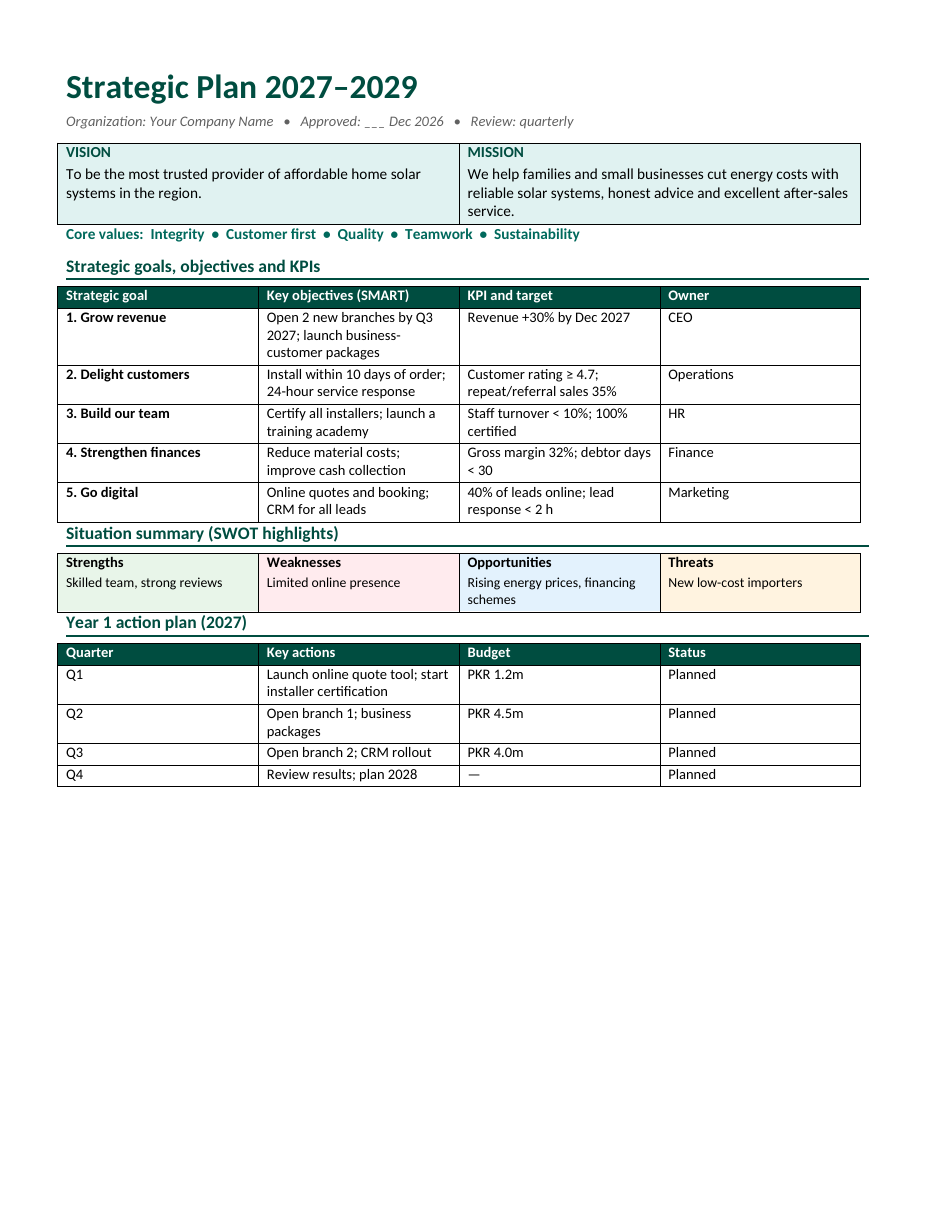
The template opens in Microsoft Word, Google Docs, LibreOffice Writer and Pages. Replace the sample text with your own organization's plan, print it and share it with your team.
What is a strategic plan?
A strategic plan is a document that sets an organization's direction for the next three to five years. It defines the vision (what you want to become), the mission (why you exist and whom you serve), the values that guide behaviour, a small number of strategic goals and the actions, owners and measures needed to achieve them. It links long-term ambition with yearly budgets and daily work.
What the template includes
- Plan title, organization name, approval date and review frequency.
- Vision and mission statements side by side.
- Core values in one line.
- A goals table with strategic goal, SMART objectives, KPI and target, and owner.
- SWOT highlights: strengths, weaknesses, opportunities and threats.
- A Year 1 action plan by quarter with key actions, budget and status.
- A one-page layout that is easy to print, share and display.
How to write a strategic plan
- Review the past year's results, customer feedback and market trends.
- Run a SWOT analysis with your leadership team.
- Agree on or update your vision and mission statements.
- Choose three to five strategic goals that matter most for the next three years.
- Turn each goal into SMART objectives: specific, measurable, achievable, relevant and time-bound.
- Pick one or two KPIs per goal and set clear targets.
- Assign an owner who is accountable for each goal.
- Break Year 1 into quarterly actions with budgets.
- Share the plan with all staff and explain how their work contributes.
- Review progress every quarter and update the plan each year.
Writing vision and mission statements
Vision
The vision describes the future you want to create, in one inspiring sentence. Example: "To be the most trusted provider of affordable home solar systems in the region."
Mission
The mission explains what you do, for whom and how. Example: "We help families and small businesses cut energy costs with reliable solar systems, honest advice and excellent after-sales service."
Setting strategic goals and KPIs
Good strategic goals are few and focused. The sample uses five: grow revenue, delight customers, build the team, strengthen finances and go digital. Each goal has objectives that describe what will be done, such as "open two new branches by Q3 2027", and KPIs that show whether it is working, such as "revenue +30% by December 2027". Choose KPIs you can actually measure every month or quarter, and avoid tracking too many numbers.
Examples of strategic KPIs
- Revenue growth and gross margin.
- Customer satisfaction rating and repeat sales.
- Staff turnover and training completion.
- Debtor days and cash balance.
- Share of leads from online channels.
- Delivery time or service response time.
Using SWOT in your plan
The SWOT highlights summarise the situation behind your goals. Strengths and opportunities point to where you can grow; weaknesses and threats show what you must fix or protect against. In the sample, a strong team and good reviews support growth, while a limited online presence explains the "go digital" goal. Rising energy prices are an opportunity, and low-cost importers are a threat that the plan answers with quality and service. For a full analysis, use a separate SWOT template and summarise the key points here.
Turning strategy into a Year 1 action plan
Strategy only matters if it turns into action. The quarterly action plan lists what will be done in Q1, Q2, Q3 and Q4, the budget needed and the current status. Link each action to a goal, and include actions in your 2027 budget. Update the status column (Planned, In progress, Done or Delayed) at every quarterly review.
Who should be involved?
Strategic planning works best when the leadership team owns it but staff contribute ideas. Hold a planning workshop with managers, invite input from front-line staff through a short survey, and talk to a few key customers. In small businesses, the owner may write the plan, but sharing it with the team builds commitment and better ideas.
Reviewing and updating the plan
- Review KPIs monthly in management meetings.
- Hold a deeper quarterly review of goals and actions.
- Adjust actions if results are off track.
- Update the plan once a year, rolling it forward by one year.
- Celebrate milestones with the team.
Common strategic planning mistakes
- Too many goals, so nothing gets real focus.
- Vague goals with no measurable targets.
- No owners, so no one is accountable.
- No link between the plan and the budget.
- Writing the plan and never reviewing it.
- Ignoring weaknesses and threats.
Strategic plan example walkthrough
The sample plan belongs to a small home solar company that wants to grow from one branch to three over three years. Its vision is to be the most trusted provider of affordable home solar systems in the region, and its mission focuses on cutting energy costs with reliable systems, honest advice and good after-sales service. Five core values, integrity, customer first, quality, teamwork and sustainability, guide how staff work every day.
The five strategic goals connect directly to the SWOT. "Grow revenue" uses the opportunity of rising energy prices and financing schemes. "Delight customers" builds on strong reviews with faster installation and service. "Build our team" protects the company's key strength, its skilled installers, through certification and a training academy. "Strengthen finances" improves margins and cash collection, and "Go digital" fixes the weakness of a limited online presence. The Year 1 action plan then schedules the online quote tool, installer certification, two branch openings and CRM rollout across the four quarters of 2027, each with a budget.
Strategic plans for different organizations
- Small businesses: focus on growth, customers, cash flow and a few key hires.
- Startups: focus on product-market fit, funding milestones and early customers.
- Schools: goals for learning outcomes, teacher development, facilities and parent engagement.
- NGOs and charities: goals for programme impact, fundraising, partnerships and governance.
- Departments: goals that support the wider organization's plan, such as HR, IT or marketing.
- Freelancers: goals for income, client mix, skills and work-life balance.
Linking the plan to your 2027 budget
A strategic plan without money is only a wish list. When you prepare the 2027 budget, start from the action plan: list every action that needs spending, such as new staff, equipment, software or marketing, and include it in the budget with the quarter it will be spent. If the budget cannot cover all actions, prioritise the ones linked to your most important goals and move others to 2028. The sample shows budgets of PKR 1.2 million, 4.5 million and 4.0 million for the first three quarters, mainly for the online tool and the two new branches.
Quick strategic planning workshop agenda
- Review of last year's results and key lessons (30 minutes).
- SWOT discussion in small groups (45 minutes).
- Vision and mission check and update (20 minutes).
- Choosing three to five strategic goals (40 minutes).
- Setting KPIs, targets and owners (40 minutes).
- Drafting the Year 1 quarterly actions (30 minutes).
- Agreeing next steps and the review calendar (15 minutes).
Frequently asked questions
Is this strategic plan template free?
Yes. Download, edit and use it for your business, school, NGO or department.
How long should a strategic plan be?
A one-page summary like this is ideal for sharing. Larger organizations may add a longer supporting document with details and financials.
How many years should a strategic plan cover?
Most plans cover three to five years, with a detailed action plan for the first year.
What is the difference between a strategic plan and a business plan?
A strategic plan sets direction and priorities for an existing organization. A business plan usually describes a new business or project in detail, including market, operations and financial forecasts, often for investors or lenders.
How often should I review the plan?
Review KPIs monthly, goals quarterly and the whole plan yearly.
Can I use this template for a school or NGO?
Yes. Replace the business goals with goals for your own organization, such as learning outcomes, programme impact or fundraising.
Related templates
- SWOT analysis template
- Action plan templates
- Executive summary templates
- Personal development plan template
- Cost-benefit analysis templates