The end of the year is when sales teams look back at results and set targets for the next twelve months. A clear sales plan turns a revenue goal into numbers each person can work towards: targets by product, by quarter and by salesperson, supported by a pipeline of real opportunities and a short list of strategies. Without a plan, targets are just hopes, and it is hard to tell in March whether the year is on track.
Our free sales plan template for Excel brings everything onto one printable sheet. Enter last year's actual sales and a growth percentage for each product line, and the template calculates the 2027 target and splits it across four quarters. A pipeline table calculates the weighted value of every open opportunity, and a strategies section lists the actions that will deliver the numbers. Preview it below and download the XLSX file.
Download the free sales plan template
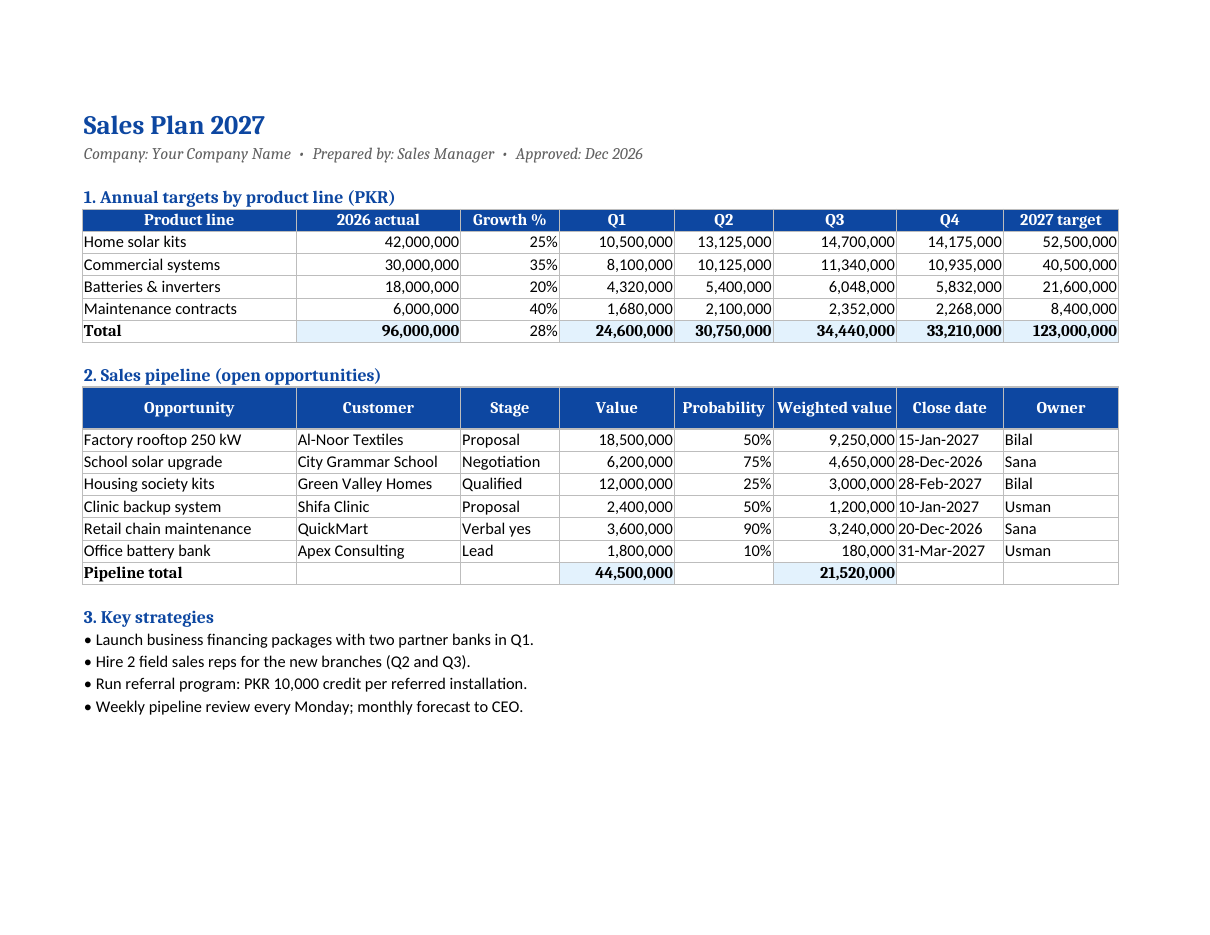
The spreadsheet works in Microsoft Excel, Google Sheets, LibreOffice Calc and Numbers. All totals and weighted values are formulas, so you only type the inputs.
What is a sales plan?
A sales plan is a document that sets sales targets for a period, usually a year, and explains how the team will reach them. It typically includes revenue targets, the products or markets that will deliver them, the sales pipeline, the resources needed such as people and budget, the main strategies and tactics, and the measures used to track progress. It is narrower than a business plan and more practical: it tells the sales team what to sell, to whom and by when.
What the template includes
- Plan title, company name, preparer and approval date.
- Annual targets by product line with last year's actual sales.
- A growth percentage for each product line.
- Automatic 2027 targets and a quarterly split based on seasonality.
- Totals for the whole company and the overall growth rate.
- A sales pipeline with opportunity, customer, stage, value, probability, weighted value, close date and owner.
- Automatic pipeline totals and weighted pipeline value.
- A key strategies section for the main actions.
- A landscape layout that prints on one page.
How to create your sales plan
- Enter your 2026 actual sales for each product line or service.
- Decide a realistic growth percentage for each line, based on market trends, capacity and past performance.
- Check the 2027 target column and the company total.
- Adjust the quarterly split percentages if your sales are seasonal.
- List every open opportunity in the pipeline with its value and stage.
- Assign a probability to each stage, such as 10% for a lead and 90% for a verbal yes.
- Compare the weighted pipeline with the Q1 target to see whether you have enough opportunities.
- Write three to six key strategies to close the gap.
- Assign owners and dates to each strategy.
- Review the plan every month and update actual sales and pipeline.
Setting realistic sales targets
A good target is ambitious but achievable. Start from last year's results, then consider market growth, price changes, new products, new salespeople, lost customers and capacity limits. In the sample, maintenance contracts grow fastest at 40% because the company has many new installations needing service, while batteries grow more slowly at 20%. The total target of PKR 123 million is 28% above the previous year. Discuss targets with the sales team: people work harder towards numbers they helped set.
Top-down and bottom-up targets
Top-down targets start from the company's revenue goal and divide it between products and people. Bottom-up targets start from each salesperson's realistic forecast and add them up. The best plans use both and discuss the difference until the numbers agree.
Splitting targets by quarter
Few businesses sell the same amount every month. The template uses a quarterly split of 20%, 25%, 28% and 27%, reflecting a slower first quarter and a stronger second half. Change these percentages to match your own sales history. A realistic split prevents the team from feeling behind in January, or relaxed in June when they should be pushing hard.
Understanding the weighted pipeline
The pipeline shows opportunities that have not yet closed. Because not every deal will be won, each one is multiplied by a probability to give a weighted value. In the sample, a PKR 18.5 million factory rooftop project at proposal stage (50%) has a weighted value of PKR 9.25 million. The total pipeline is PKR 44.5 million, but the weighted value is PKR 21.5 million, which is the more realistic forecast. If the weighted pipeline is below the next quarter's target, the team needs to find more opportunities now.
Typical stage probabilities
- Lead: 10%.
- Qualified: 25%.
- Proposal sent: 50%.
- Negotiation: 75%.
- Verbal yes: 90%.
- Won: 100% (move to actual sales).
Sales strategies that support the plan
- Focus on the products and customers with the highest margins.
- Add new channels such as partners, distributors or online sales.
- Offer financing or payment plans to help customers buy.
- Start a referral program that rewards existing customers.
- Hire or train salespeople ahead of busy seasons.
- Hold a weekly pipeline review and a monthly forecast meeting.
- Track activity measures such as calls, meetings and proposals sent.
Tracking progress during the year
A plan is only useful if you compare it with results. Each month, record actual sales by product line next to the target, calculate the variance and update the pipeline. Look at the trend, not just a single month. If you are behind after a quarter, decide quickly whether to add more opportunities, change prices, focus on different customers or adjust the target with management approval.
Who uses a sales plan template?
- Small business owners planning next year's revenue.
- Sales managers setting team and individual targets.
- Startups preparing forecasts for investors.
- Distributors and wholesalers planning by product line.
- Service companies planning contracts and renewals.
- Freelancers planning client work and income.
Sales plan example walkthrough
The sample plan belongs to a solar energy company with four product lines. Home solar kits sold PKR 42 million in 2026 and are planned to grow 25% to PKR 52.5 million. Commercial systems grow 35% to PKR 40.5 million because the company is targeting factories and schools. Batteries and inverters grow 20%, and maintenance contracts grow 40% from a small base. In total, the company aims for PKR 123 million, with PKR 24.6 million in the first quarter.
The pipeline shows six open opportunities worth PKR 44.5 million in total, or PKR 21.5 million weighted. Two deals, the school upgrade and the retail chain maintenance contract, are expected to close in December, giving a good start to the year. The strategies support the targets directly: financing packages help homeowners and businesses afford larger systems, new field reps cover the new branches, a referral program brings in leads at low cost, and weekly pipeline reviews keep the team focused.
Building targets for each salesperson
Once the company target is agreed, divide it between salespeople. Consider each person's territory, customer base, experience and the size of their pipeline. New salespeople usually need a lower target for the first few months while they build relationships. Add a column for the owner of each product line or territory, or create a copy of the sheet for each salesperson. Make sure the individual targets add up to at least the company target, with a small buffer in case someone leaves or falls behind.
Common sales planning mistakes
- Setting targets without looking at last year's actual results.
- Ignoring seasonality and expecting the same sales every month.
- Counting the full pipeline value instead of the weighted value.
- Writing strategies without owners or deadlines.
- Leaving the plan in a drawer and never reviewing it.
- Changing targets every month, which confuses the team.
Presenting the plan to your team
Share the sales plan at a kick-off meeting in December or early January. Explain the company target, how it was set and what it means for each person. Walk through the key strategies and the support the team will receive, such as new leads, financing options or training. Print the one-page plan or share it as a PDF so everyone can refer to it during the year.
Frequently asked questions
Is this sales plan template free?
Yes. Download, edit and use it for your business.
Can I add more product lines?
Yes. Insert rows above the total row and copy the formulas down. Check that the SUM ranges include the new rows.
Can I plan by month instead of quarter?
Yes. Add twelve month columns and use monthly percentages that add up to 100%.
What is a good pipeline coverage ratio?
Many sales teams aim for a total pipeline of about three times the target for the next period, but the right ratio depends on your win rate.
How often should I update the sales plan?
Update actual sales and the pipeline weekly or monthly, and review targets and strategies every quarter.
Should the sales plan include costs?
A sales plan focuses on revenue, but you can add a section for sales costs such as commissions, travel and marketing to check that growth is profitable.
Related templates
- Sales report templates
- Weekly marketing report templates
- Action plan templates
- SWOT analysis template
- Proposal template