
A strong proposal can be the difference between winning and losing a project. Whether you are a freelancer pitching a new client, an agency responding to a brief, a contractor bidding for work or a non-profit seeking a partnership, the proposal is where you show that you understand the client's problem and have the right solution at a fair price. A clear, well-organized document makes it easy for the client to say yes.
Our free business proposal template for Microsoft Word follows a proven structure: executive summary, the challenge, the proposed solution, timeline, investment, and next steps with an acceptance line. The example is a website redesign proposal for a dental clinic, but every section is easy to adapt to your services. Preview the template below, download the editable DOCX file and use our guide to write proposals that win business.
Download the free business proposal template
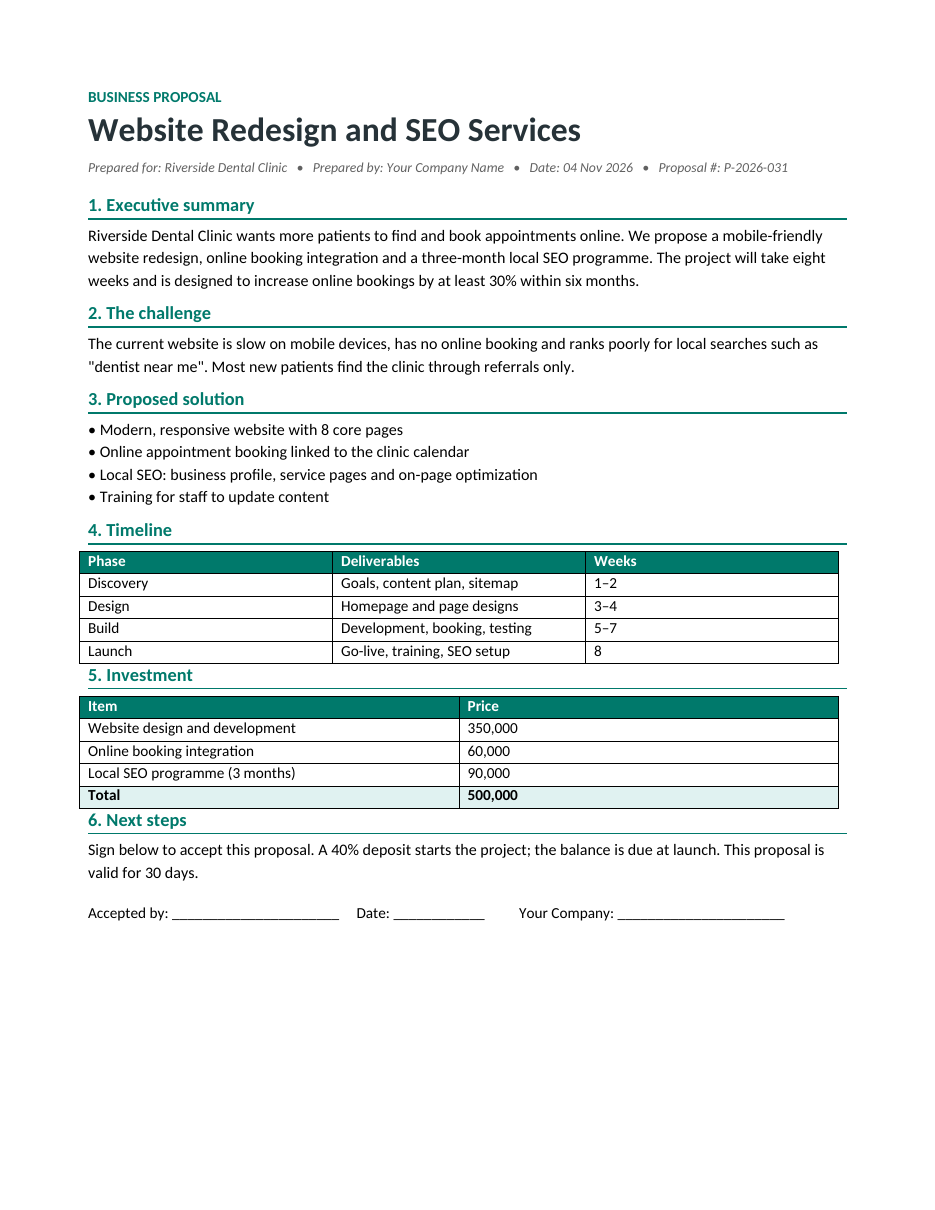
The template opens in Microsoft Word, Google Docs, LibreOffice Writer and Pages. Replace the sample text with your own, update the tables and save it as a PDF to send to your client.
What is a business proposal?
A business proposal is a document sent by a seller to a prospective client that describes a problem or need, presents a solution and sets out the cost, timeline and terms. Proposals can be solicited, when a client asks for bids or issues a request for proposal (RFP), or unsolicited, when you approach a client with an idea. Either way, the goal is to persuade the client that you understand their needs and are the best choice to meet them.
What the proposal template includes
- A title block with the project name, client, your company, date and proposal number.
- An executive summary that states the client's goal and your solution in a few sentences.
- The challenge: the client's problem in their own terms.
- The proposed solution with a clear list of deliverables.
- A timeline table with phases, deliverables and weeks.
- An investment table with itemized prices and a total.
- Next steps, payment terms and validity period.
- An acceptance line for the client's signature.
How to write a winning business proposal
- Research the client: their business, goals, competitors and the problem they want to solve.
- Ask questions in a discovery call to understand budget, timeline and decision-makers.
- Write the executive summary last, after you have worked out the details.
- Describe the challenge in the client's language, using facts they shared with you.
- Present the solution as outcomes and benefits, not just tasks.
- List deliverables clearly so there is no confusion about scope.
- Set a realistic timeline with phases and milestones.
- Price the project clearly and show what each item includes.
- Explain the next steps and how to accept.
- Proofread carefully, save as PDF and send with a short, friendly cover email.
- Follow up within a few days to answer questions.
Section-by-section guide
Executive summary
This is the most-read part of the proposal. In three to five sentences, restate the client's goal, summarize your solution and highlight the main result they can expect, such as "increase online bookings by 30% within six months".
The challenge
Show that you have listened. Describe the client's current situation and why it is a problem, using specifics: a slow website, no online booking, poor rankings for local searches. Clients are more likely to trust a provider who clearly understands their pain points.
Proposed solution
Explain what you will do and why it solves the problem. Use bullet points for deliverables and connect each one to a benefit. Avoid jargon; the reader may not be a specialist.
Timeline
Break the project into phases with deliverables and target dates. A visible plan reassures the client that the project is organized and realistic.
Investment
Present prices in a simple table. Call it "investment" rather than "cost" to emphasize value. If appropriate, offer two or three options at different price levels so the client can choose.
Next steps and acceptance
Tell the client exactly how to proceed: sign the acceptance line, pay a deposit or book a kickoff call. State payment terms and how long the proposal is valid.
Proposal writing tips
- Keep it client-focused; use "you" more than "we".
- Be concise; most proposals work best at two to six pages.
- Use headings, bullets and tables to make the document easy to scan.
- Include proof such as short case studies, results or testimonials from your own clients.
- Be specific about what is and is not included in the scope.
- Match the client's branding level; a polished design builds confidence.
- Send the proposal quickly while interest is high.
- Always include a clear call to action.
Common proposal mistakes
- Talking about your company for pages before addressing the client's needs.
- Vague scope that leads to disputes later.
- Hidden costs or unclear pricing.
- No deadline or validity period.
- Spelling errors and the wrong client name copied from another proposal.
- No clear way to accept or next step.
- Sending a generic proposal that is not tailored to the client.
Pricing strategies for proposals
There are several ways to price a proposal. Fixed-price projects give clients certainty and work well when the scope is clear. Hourly or daily rates suit work where the scope is likely to change. Retainers cover ongoing services, such as monthly SEO or bookkeeping. Value-based pricing links the fee to the result the client will gain. Offering tiered packages, such as basic, standard and premium, gives clients a sense of choice and often leads them to pick the middle option.
Adapting the template for different industries
The structure works for almost any service. A cleaning company can describe the client's facility, list cleaning tasks and frequency, and price by month. A marketing consultant can outline campaigns and expected results. A construction contractor can add sections on materials, permits and site safety. An event planner can include the venue, catering and a day-of schedule. Simply rename the sections, update the tables and keep the logical flow from problem to solution to price to action.
Following up after sending a proposal
Many proposals are won or lost in the follow-up. Send a short email the day after to confirm the client received the document and offer to walk them through it on a call. If you have not heard back within a week, follow up again with a helpful note, such as an answer to a likely question or a reminder of the main benefit. Keep a simple record of every proposal you send, the value, the date and the outcome, so you can see your win rate and improve your pricing and approach over time.
What to include in a proposal cover email
Your cover email should be short and personal. Thank the client for the conversation, mention the main goal you discussed, attach the proposal as a PDF and suggest a time to review it together. For example: "Thank you for meeting with us on Tuesday. Attached is our proposal for redesigning your website and adding online booking, which we expect to increase online appointments by at least 30%. I would be happy to walk you through it on a short call this Thursday or Friday." A clear, friendly email sets the tone for the proposal and makes it easy for the client to reply.
Frequently asked questions
Is this business proposal template free?
Yes. Download, edit and use it for your business as often as you like.
How long should a business proposal be?
Long enough to answer the client's questions and no longer. For small projects, two to four pages are usually enough; complex bids may need more detail.
Is a signed proposal a contract?
A signed proposal can form a binding agreement, but for larger projects it is wise to use a separate contract reviewed by a legal professional.
Should I include a cover letter?
A short cover email or letter introducing the proposal is helpful. Keep it to a few sentences and attach the proposal as a PDF.
Can I add my logo?
Yes. Insert your logo at the top of the first page or in the header, and change the teal colour to match your brand.
How do I handle a client who says the price is too high?
Ask which parts matter most to them, then offer a smaller scope, a phased approach or a different package rather than simply cutting your rate.
Can I reuse this proposal for every client?
Reuse the structure, but always tailor the challenge, solution and pricing to each client. Generic proposals win far less often.
How soon should I send a proposal after a meeting?
Ideally within two to three working days, while the conversation is fresh. If the project is complex, send a short note confirming when the client can expect the full proposal.
Related templates
- Quotation templates
- Executive summary templates
- Agreement templates
- Action plan templates
- Letterhead templates