
If you export goods, the certificate of origin is one of the documents that can make or break a shipment. Customs authorities use it to determine which duties apply and whether your goods qualify for preferential tariffs under trade agreements. A missing or incorrect certificate can lead to delays at the border, higher duties or rejected shipments. Our free certificate of origin template for Microsoft Word gives exporters, freight forwarders and trade professionals a clear, structured form that follows the layout commonly used for non-preferential certificates.
Preview the template below, download the editable DOCX file, and read our guide to completing a certificate of origin accurately.
Download the free certificate of origin template
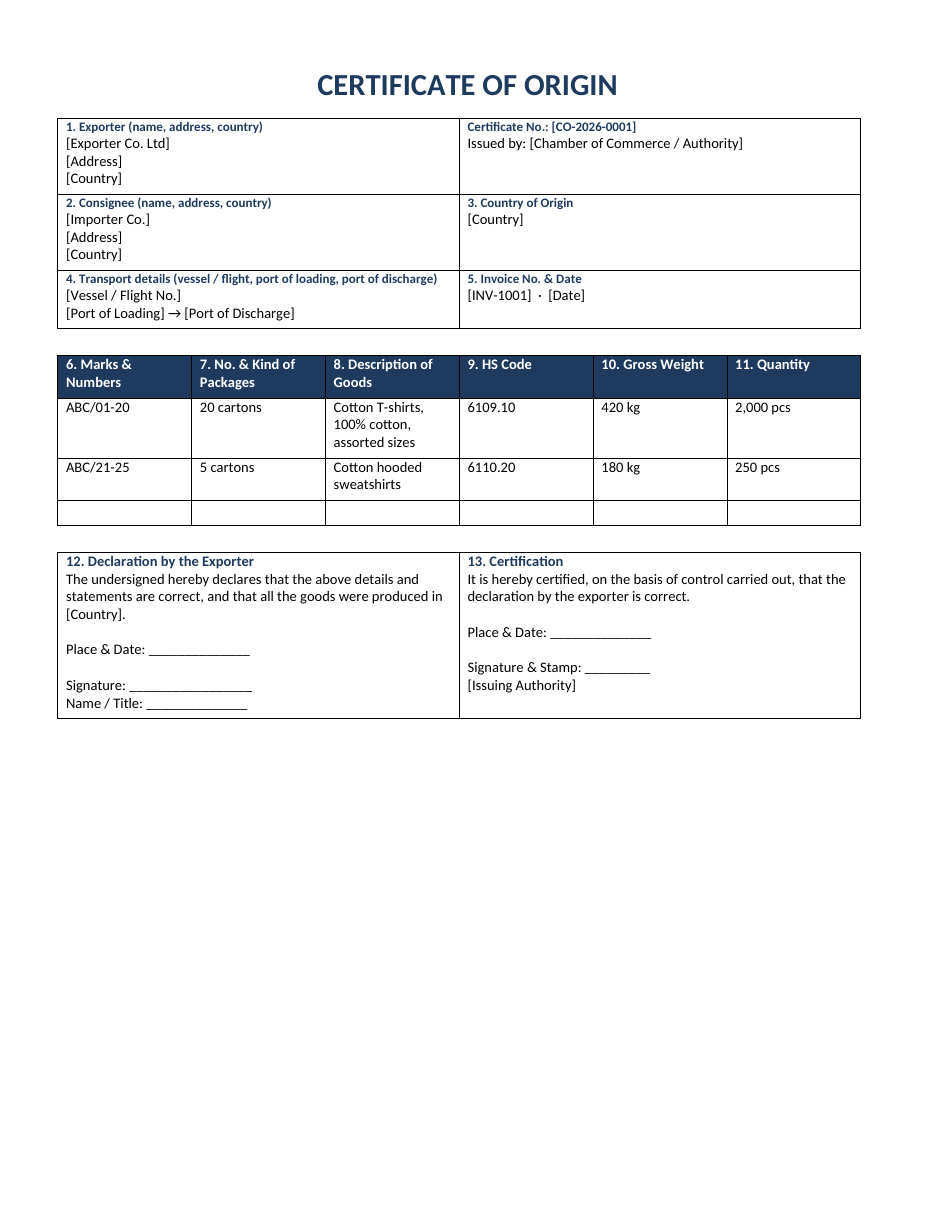
The template opens in Microsoft Word, Google Docs, LibreOffice Writer and Pages. Note that many countries require certificates of origin to be issued or certified by a chamber of commerce or customs authority, and preferential certificates often have mandatory official formats. Use this template to prepare information, for internal records, as a draft for certification or where a commercial certificate of origin is accepted by your buyer.
What is a certificate of origin?
A certificate of origin (CO or COO) is an international trade document that certifies the country in which goods were wholly obtained, produced, manufactured or processed. It is usually prepared by the exporter and, in many cases, certified by an authorized body such as a chamber of commerce. Importing countries use the certificate to apply the correct customs duties, enforce trade restrictions or anti-dumping measures, compile trade statistics and determine eligibility for reduced or zero tariffs under free trade agreements.
Preferential vs. non-preferential certificates of origin
Non-preferential certificate of origin
Also called an ordinary or general certificate of origin, it simply confirms the country of origin. It does not grant any tariff reduction but may be required by the importing country, a letter of credit or the buyer.
Preferential certificate of origin
Certifies that goods meet the rules of origin under a specific trade agreement, allowing the importer to claim reduced or zero duties. Examples include EUR.1 movement certificates, Form A under the Generalised System of Preferences and certificates under regional agreements. These usually have mandatory formats, and some agreements now allow origin declarations on the invoice instead.
What this certificate of origin template includes
- Exporter – the name, address and country of the exporting company.
- Certificate number and issuing authority – a unique reference and the chamber or authority certifying the document.
- Consignee – the name, address and country of the importer or recipient.
- Country of origin – where the goods were produced.
- Transport details – vessel or flight number, port of loading and port of discharge.
- Invoice number and date – linking the certificate to the commercial invoice.
- Marks and numbers – package markings that match the shipment.
- Number and kind of packages – for example 20 cartons or 3 pallets.
- Description of goods – a clear commercial description.
- HS code – the Harmonized System tariff classification.
- Gross weight and quantity – matching the packing list and invoice.
- Exporter's declaration – a signed statement that the details are correct.
- Certification – a box for the issuing authority's signature and stamp.
How to complete a certificate of origin
- Enter the exporter's full legal name and address exactly as they appear on the commercial invoice.
- Enter the consignee's details as listed on the invoice and bill of lading or airway bill.
- State the country of origin based on the applicable rules of origin, not simply the country you are shipping from.
- Add transport details, including the vessel or flight and the ports of loading and discharge.
- Reference the commercial invoice number and date.
- For each line of goods, enter the package marks, number and type of packages, a clear description, the HS code, gross weight and quantity.
- Check that every figure matches the commercial invoice and packing list exactly.
- Sign the exporter's declaration, adding the place, date, name and title of the authorized signatory.
- Submit the certificate, with supporting documents if required, to the chamber of commerce or authority for certification.
- Send the certified original to the importer or bank according to the sales contract or letter of credit.
How to determine the country of origin
Origin is not always obvious when goods contain materials from several countries. Rules of origin generally treat goods as originating in a country if they are wholly obtained there, such as crops grown or minerals extracted, or if they underwent substantial transformation there. Substantial transformation may be defined by a change in HS tariff classification, a minimum percentage of local value added or specific processing operations. Simple operations such as packaging, labelling or minor assembly usually do not confer origin. Check the rules for your product and destination, and keep supplier declarations and cost records to support your claim.
Understanding HS codes
The Harmonized System is an international nomenclature that classifies traded products using six-digit codes, which countries extend to eight or ten digits for their own tariffs. For example, cotton T-shirts fall under heading 6109. Using the correct HS code is essential because it determines duty rates and origin rules. Search your national customs tariff database, consult a customs broker or request a binding tariff ruling if you are unsure.
Common certificate of origin mistakes
- Details that do not match the commercial invoice, packing list or bill of lading.
- Incorrect or missing HS codes.
- Vague descriptions such as "garments" or "parts" instead of specific product descriptions.
- Claiming origin based on the shipping country rather than rules of origin.
- Missing signature, date or certification stamp.
- Using the wrong form for preferential treatment.
- Spelling errors in company names or addresses.
- Submitting the certificate after the shipment has already arrived without checking whether retrospective issue is allowed.
Supporting documents to keep on file
- Commercial invoice and packing list.
- Bill of lading or airway bill.
- Supplier declarations or manufacturer's affidavits.
- Bills of materials and cost breakdowns showing value added.
- Production records.
- Copies of all certificates issued, kept for the retention period required by customs, often five years or more.
Electronic certificates of origin
Many chambers of commerce now offer electronic certificates of origin, allowing exporters to submit applications online, upload supporting documents and receive digitally certified certificates with secure verification codes. Electronic systems speed up processing and reduce courier costs. You can still use this Word template to prepare and check your data before entering it into an online portal, ensuring every field is correct the first time.
Tips for small exporters
If you are new to exporting, start by confirming the documentation requirements with your buyer and freight forwarder before you ship. Ask whether the importing country or the letter of credit requires a certified certificate, a preferential form or simply an origin statement on the invoice. Register with your local chamber of commerce early, as account setup can take time. Keep a master copy of this template with your company details pre-filled, and create a new certificate for each shipment using the same invoice number for easy cross-referencing. Finally, build a simple checklist for every export shipment covering the commercial invoice, packing list, certificate of origin, transport document and any licences or inspection certificates.
Certificate of origin and letters of credit
When a shipment is paid by documentary letter of credit, the bank will examine every document against the credit terms before releasing payment. If the letter of credit requires a certificate of origin, check exactly which issuer, wording and number of originals or copies are required. Even a small discrepancy, such as a slightly different description of goods or a consignee name that does not match the credit, can lead the bank to refuse the documents and delay payment. Use the credit wording when completing the template, compare it line by line with the invoice and transport document, and have a colleague double-check before submission.
Frequently asked questions
Is this certificate of origin template free?
Yes. Download and edit it free for preparing export documentation.
Who issues a certificate of origin?
The exporter usually prepares it, and a chamber of commerce, customs authority or other designated body certifies it where required.
Is a certificate of origin always required?
No. It depends on the importing country, the products, the trade agreement and the buyer's or bank's requirements.
Can I use the template for preferential origin claims?
Preferential certificates often require official forms or specific declarations. Use this template for non-preferential certificates, drafts and internal records, and check the rules of the relevant trade agreement.
How long is a certificate of origin valid?
Validity depends on the destination country and agreement, commonly between six and twelve months from issue.
Related templates
Prepare the rest of your shipping paperwork with our packing list template, invoice templates, quotation template and remittance templates.