A strong cover letter can be the difference between an application that is skimmed and one that leads to an interview. Your resume lists what you have done; your cover letter explains why you want this particular job, what you can bring to the employer and why you are a good fit. Hiring managers often read the cover letter first, so a clear, confident and well-structured letter makes a powerful first impression.
Our free cover letter template for Microsoft Word gives you a clean, modern layout with a name header, contact line, accent divider, recipient block, subject line, a focused introduction, achievement bullet points and a polite closing. The sample is written for a Digital Marketing Manager role and shows exactly how to present results with numbers. Preview it below, download the DOCX and use our step-by-step guide to write your own letter.
Download the free cover letter template
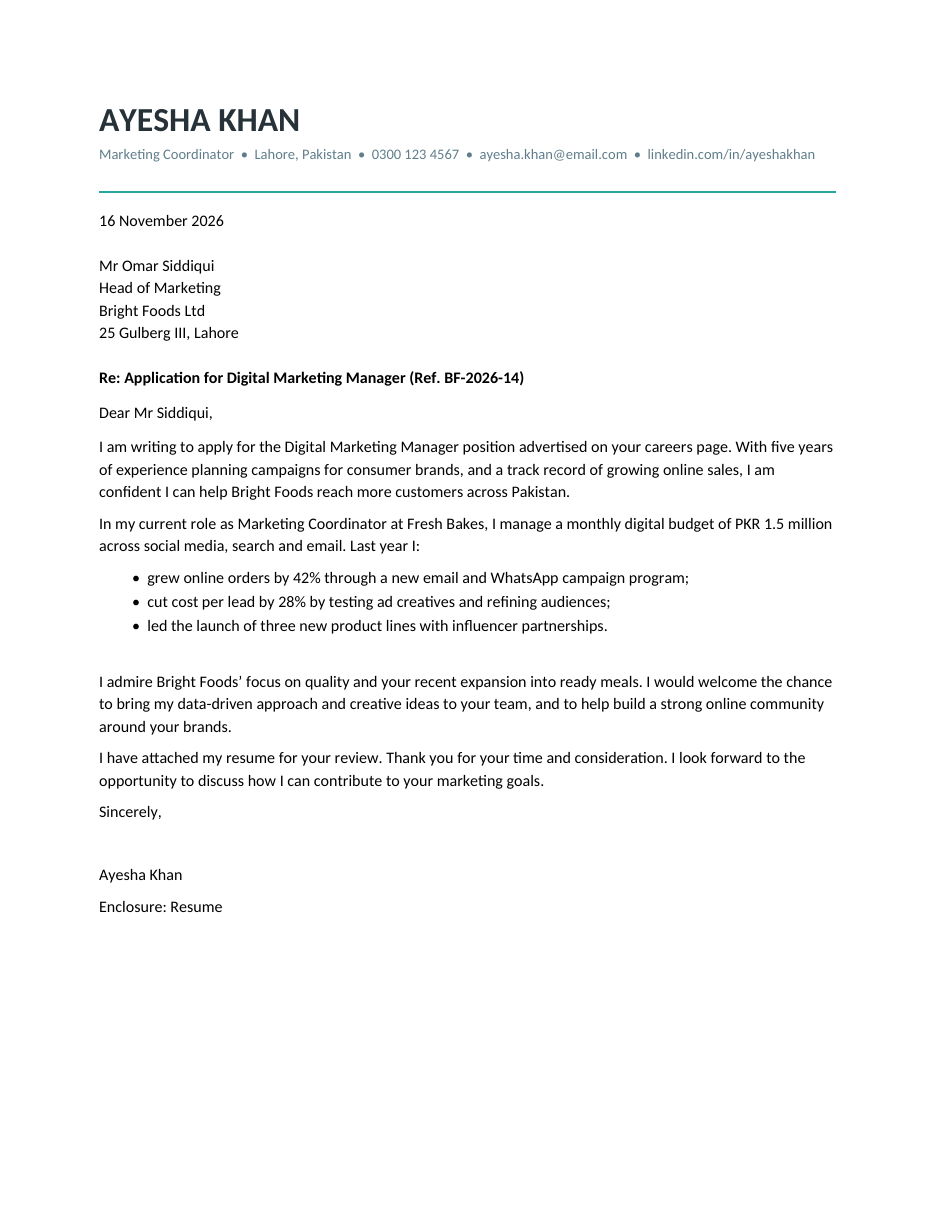
The template opens in Microsoft Word, Google Docs, LibreOffice Writer and Pages. Replace the sample text with your own details and save the final letter as a PDF before sending.
What the template includes
- A bold name header and a single contact line with phone, email, city and LinkedIn profile.
- A teal accent line that matches modern resume designs.
- Date and full recipient details.
- A subject line with the job title and reference number.
- A personalized greeting.
- An opening paragraph that names the role and your main strength.
- A paragraph with three achievement bullet points.
- A paragraph showing why you want to work for this employer.
- A closing paragraph with a call to action.
- Signature and enclosure line.
How to write a cover letter
- Read the job advertisement carefully and highlight the key skills and requirements.
- Research the company: its products, values, recent news and culture.
- Find the name of the hiring manager if possible.
- Open with the job title and a one-sentence summary of why you are a strong candidate.
- In the middle paragraph, give two or three achievements that match the job requirements, with numbers where possible.
- Explain why you want to work for this employer specifically.
- Close by thanking the reader and saying you look forward to discussing the role.
- Keep the letter to one page and about 250 to 400 words.
- Proofread carefully, then ask someone else to check it.
- Save it as a PDF named with your name and the job title.
Structure of a professional cover letter
Header
Use the same name style and contact details as your resume so your application looks consistent. Include a professional email address and a phone number you answer.
Recipient and subject line
Address the letter to a named person whenever you can. A subject line with the job title and any reference number helps the employer file your application correctly.
Opening paragraph
State the role you are applying for and where you saw it, then give a short summary of your experience and the value you offer. Avoid generic openings such as "I am writing to express my interest" without saying anything specific.
Middle paragraphs
This is where you prove your claims. Choose achievements that match the job description and show results: percentages, amounts, time saved or customers served. Bullet points make achievements easy to scan.
Closing paragraph
Thank the reader, mention that your resume is attached and express enthusiasm for an interview. Finish with "Sincerely" or "Kind regards" and your name.
Tips for a cover letter that gets interviews
- Write a new letter for each job; never send the same generic letter to everyone.
- Use keywords from the job advertisement, as many employers use applicant tracking systems.
- Focus on what you can do for the employer, not only what you want.
- Show results with numbers rather than listing duties.
- Keep sentences short and the tone confident and polite.
- Match the font and colours to your resume.
- Check the company name, job title and recipient name carefully.
- Send it as a PDF unless the employer asks for a Word file.
Common cover letter mistakes
- Repeating the resume word for word.
- Writing more than one page.
- Using "To whom it may concern" when a name is easy to find.
- Spelling or grammar errors, especially in the company name.
- Focusing on salary or benefits.
- Using an informal tone or unprofessional email address.
- Forgetting to attach the resume.
Cover letters for different situations
Fresh graduates
Focus on education, internships, projects, volunteer work and transferable skills such as teamwork and communication.
Career changers
Explain why you are changing careers and highlight transferable skills and relevant training.
Internal applications
Mention your current role, your knowledge of the organization and achievements colleagues will recognise.
Unsolicited applications
Explain why you are interested in the company and what kind of role you are looking for, and ask for a conversation.
Sample cover letter walkthrough
The sample letter is from Ayesha Khan, a marketing coordinator applying for a Digital Marketing Manager role at a food company. Her header uses the same style as a modern resume: her name in bold capitals, followed by her current title, city, phone, email and LinkedIn profile on one line. The date and the hiring manager's full name, title, company and address come next, followed by a bold subject line with the job title and the reference number from the advertisement.
The first paragraph names the role, where she found it and her five years of experience in consumer brands, ending with a clear statement of value: helping the company reach more customers. The second paragraph gives context, a PKR 1.5 million monthly digital budget, and three bullet points with measurable results: 42% more online orders, 28% lower cost per lead and three product launches. The third paragraph shows she has researched the company by mentioning its focus on quality and its expansion into ready meals. The final paragraph thanks the reader, mentions the attached resume and asks for an interview.
Words and phrases that strengthen a cover letter
- Action verbs: led, launched, grew, reduced, improved, managed, delivered.
- Results: "increased sales by 30%", "cut costs by PKR 2 million", "served 500 customers a month".
- Fit: "your focus on quality matches my approach to…".
- Confidence: "I am confident I can…", "I would welcome the opportunity to…".
- Courtesy: "Thank you for your time and consideration."
Cover letter checklist before you send
- The recipient's name, title and company are spelled correctly.
- The job title and reference number match the advertisement.
- The letter fits on one page.
- At least two achievements include numbers.
- The letter mentions something specific about the employer.
- Fonts and header match your resume.
- There are no spelling or grammar errors.
- The file is saved as a PDF with a clear name, such as "Ayesha-Khan-Cover-Letter.pdf".
- Your resume is attached.
Following up after you apply
If you have not heard back within one to two weeks, it is acceptable to send a short, polite follow-up email. Mention the role, the date you applied and your continued interest, and offer to provide any further information. Keep it brief and professional. Many candidates never follow up, so a courteous message can help keep your application in mind.
Formatting your cover letter
- Use a clean font such as Calibri, Lato or Arial at 10.5 to 12 points.
- Keep margins between 0.75 and 1 inch.
- Align text to the left; avoid justified text, which can create uneven gaps.
- Leave a blank line between paragraphs.
- Use bold only for your name and the subject line.
- Keep colour to a single accent that matches your resume.
Good formatting makes the letter easy to read in a few seconds. Hiring managers often review many applications in one sitting, so a tidy layout with short paragraphs and clear bullet points helps your strongest points stand out. Avoid images, unusual fonts and heavy decoration, which can distract from your message and may not display correctly in applicant tracking systems.
Frequently asked questions
Is this cover letter template free?
Yes. Download, edit and use it for any job application.
How long should a cover letter be?
Usually three to five short paragraphs, or about 250 to 400 words, fitting on one page.
Do I still need a cover letter?
Many employers still read cover letters, and a good one helps you stand out, especially when the advertisement asks for one.
Should my cover letter match my resume?
Yes. Use the same name header, fonts and colours for a professional, consistent application.
Can I send the cover letter in the email body?
Yes. If you are applying by email, you can paste a shorter version into the email and attach the full letter and resume as PDFs.
Should I mention salary in my cover letter?
Only if the advertisement asks for salary expectations. Otherwise, leave salary for the interview stage.
Can I use this template for an email application?
Yes. Copy the body paragraphs into your email, keep the subject line, and attach the full letter and resume as PDFs.
Related templates
- Resume templates
- Letterhead templates
- Salary increase letter templates
- Personal development plan template
- Weekly planner templates