As the year draws to a close, every business needs a clear picture of what it owns and what it owes. The balance sheet provides exactly that: a snapshot of assets, liabilities and equity at a specific date, usually the last day of the financial year. Lenders, investors, tax advisers and business owners all rely on the balance sheet to judge financial health, liquidity and stability. Preparing one does not have to be complicated when you start with a well-structured template.
Our free balance sheet template for Excel presents current and non-current assets, current and non-current liabilities and equity, with columns for this year, last year and the change between them. Totals calculate automatically, and a built-in check confirms that total assets equal total liabilities plus equity. Preview the template below, download the XLSX file and use our step-by-step guide to prepare a professional year-end balance sheet.
Download the free balance sheet template
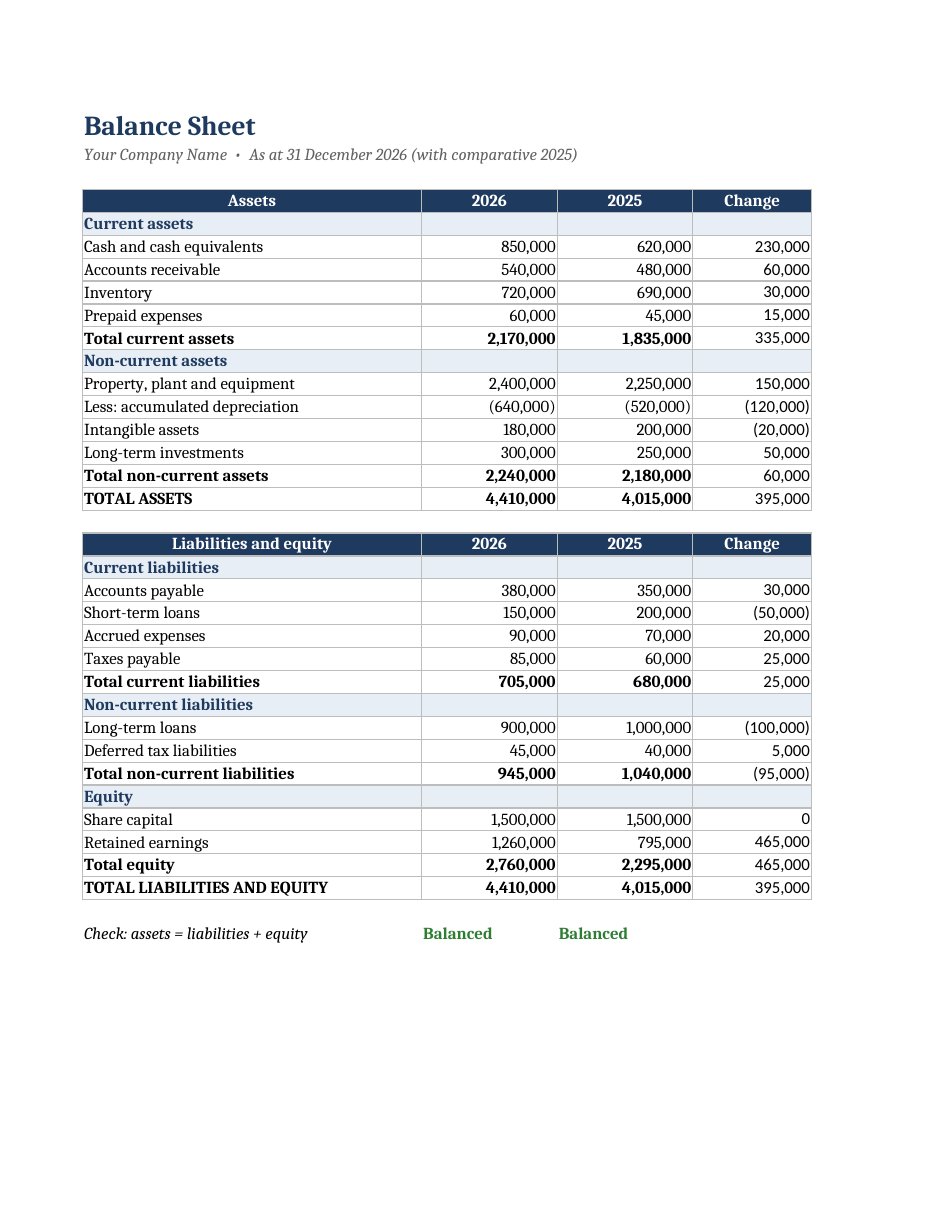
The spreadsheet opens in Microsoft Excel, Google Sheets, LibreOffice Calc and Numbers. Replace the sample figures with your own; all subtotals, totals, change values and the balance check update automatically.
What is a balance sheet?
A balance sheet, also called a statement of financial position, is one of the three core financial statements, alongside the income statement and the cash flow statement. It shows a company's assets, liabilities and owners' equity at a single point in time. The balance sheet is based on the fundamental accounting equation: assets equal liabilities plus equity. In other words, everything a business owns is financed either by borrowing (liabilities) or by the owners' investment and retained profits (equity).
What this balance sheet template includes
- Company name and reporting date in the header.
- Current assets: cash and cash equivalents, accounts receivable, inventory and prepaid expenses.
- Non-current assets: property, plant and equipment, accumulated depreciation, intangible assets and long-term investments.
- Current liabilities: accounts payable, short-term loans, accrued expenses and taxes payable.
- Non-current liabilities: long-term loans and deferred tax liabilities.
- Equity: share capital and retained earnings.
- Automatic subtotals for each section and grand totals.
- Comparative columns for the current and previous year.
- A change column showing increases and decreases.
- A balance check that displays "Balanced" when the equation holds.
How to prepare a balance sheet step by step
- Choose the reporting date, usually the last day of your financial year or month.
- Run a trial balance from your accounting records to obtain closing balances for every account.
- Enter cash balances from reconciled bank statements.
- Enter accounts receivable from your customer ledger, net of any allowance for bad debts.
- Record inventory at cost or net realizable value, based on a stock count.
- Enter prepaid expenses, such as insurance or rent paid in advance.
- Record fixed assets at cost and enter accumulated depreciation as a negative figure.
- Enter current liabilities from your supplier ledger, loan statements and tax records.
- Enter long-term loans, splitting out the portion due within twelve months as a current liability.
- Enter share capital and retained earnings, which should equal last year's retained earnings plus this year's profit, minus dividends.
- Check that the balance check shows "Balanced"; if not, review your entries.
- Review the change column to explain significant movements.
Understanding the sections
Current assets
Assets expected to be converted into cash or used up within twelve months, such as cash, receivables, inventory and prepaid expenses. They indicate how easily the business can meet short-term obligations.
Non-current assets
Long-term resources used to run the business, such as buildings, machinery, vehicles, computers, software and long-term investments. Tangible assets are shown net of accumulated depreciation.
Current liabilities
Obligations due within twelve months, including supplier invoices, short-term borrowing, wages and taxes owed.
Non-current liabilities
Debts and obligations due after more than twelve months, such as bank loans, leases and deferred tax.
Equity
The owners' interest in the business: capital invested plus profits retained in the business. For sole traders and partnerships, equity is often shown as owner's capital and drawings.
Key ratios from your balance sheet
- Current ratio = current assets ÷ current liabilities. A ratio above 1.5 usually indicates healthy short-term liquidity.
- Quick ratio = (current assets − inventory) ÷ current liabilities, a stricter liquidity test.
- Debt-to-equity ratio = total liabilities ÷ total equity, showing how much the business relies on borrowing.
- Working capital = current assets − current liabilities, the cushion available for day-to-day operations.
- Return on equity = net profit ÷ equity, linking the balance sheet to the income statement.
Using the sample figures, the current ratio is 2,170,000 ÷ 705,000, or about 3.1, and working capital is 1,465,000, indicating strong short-term liquidity.
Why the comparative column matters
A single balance sheet tells you where the business stands today; comparing it with the previous year tells you which direction it is moving. Rising cash and falling debt suggest improving financial strength, while growing receivables could signal slower customer payments. The change column highlights these movements instantly, helping you explain results to lenders, investors or your board and identify areas that need attention.
Common balance sheet mistakes
- Forgetting to reconcile bank accounts before entering cash.
- Recording fixed assets without accumulated depreciation.
- Classifying long-term loans entirely as non-current, ignoring the current portion.
- Omitting accrued expenses such as unpaid wages or utilities.
- Retained earnings that do not match the income statement and dividends.
- Mixing personal and business assets.
- Using inconsistent dates for different accounts.
Year-end closing checklist
- Reconcile all bank and credit card accounts.
- Count inventory and adjust records.
- Review receivables and write off bad debts.
- Record depreciation for the year.
- Accrue unpaid expenses and defer prepaid income.
- Confirm loan balances with lender statements.
- Calculate tax payable.
- Prepare the income statement and update retained earnings.
- Prepare the balance sheet and check that it balances.
- Back up records and lock the accounting period.
Who uses balance sheets?
Business owners use balance sheets to understand financial position and plan growth. Banks review them before approving loans or overdrafts. Investors and shareholders assess value and risk. Suppliers may check them before offering credit terms. Tax authorities and auditors use them to verify financial statements. Even small businesses and sole traders benefit from preparing a balance sheet each year, because it encourages good record-keeping and reveals problems early.
Balance sheet example explained
The sample figures in the template show a growing business. Cash increased by 230,000 during the year, and receivables rose by 60,000 as sales grew. Property, plant and equipment rose by 150,000 because the company bought new equipment, while accumulated depreciation increased by 120,000. On the other side, short-term loans fell by 50,000 and long-term loans fell by 100,000 as the business repaid debt. Retained earnings rose by 465,000, reflecting profit kept in the business after dividends. Total assets and total liabilities plus equity both equal 4,410,000, so the check cell shows "Balanced".
Reading a balance sheet this way, line by line and year against year, turns a table of numbers into a story about the business. It shows where cash came from and where it went, whether the business is becoming more or less dependent on borrowing, and how much value the owners have built up over time.
Balance sheets for small businesses and sole traders
Small businesses can simplify the template by deleting rows that do not apply. A freelancer might only need cash, receivables, equipment, a credit card balance and owner's equity. Rename "Share capital" to "Owner's capital" and add a row for "Drawings" as a negative figure to show money taken out of the business. Even a simple balance sheet prepared once a year helps you track the value of your business, supports loan applications and makes tax time easier.
Frequently asked questions
Is this balance sheet template free?
Yes. Download and use it for your business, clients or accounting studies.
Why does my balance sheet not balance?
Common causes are missing entries, incorrect retained earnings, depreciation entered as positive or a liability recorded as an asset. Review each section against your trial balance.
Can I use the template monthly?
Yes. Change the column headings to months or quarters and enter balances at each period end.
What is the difference between a balance sheet and a profit and loss statement?
The balance sheet shows financial position at a point in time, while the profit and loss statement shows income and expenses over a period.
Does this replace professional accounting advice?
No. The template helps you organize figures, but statutory accounts and tax filings should be reviewed by a qualified accountant.
How often should I prepare a balance sheet?
Most businesses prepare one at each financial year end, but monthly or quarterly balance sheets give better control over cash, debt and working capital.
Where does retained earnings come from?
Retained earnings equals last year's balance plus this year's net profit, minus any dividends or drawings. Link it to your profit and loss statement to keep the two statements consistent.
Related templates
- General ledger templates
- Cost-benefit analysis template
- Sales report templates
- Executive summary templates
- Cash receipt template