
Renting out a home or flat is a big financial and personal commitment for both landlord and tenant. A written rental agreement sets out the rules from the start: how much rent is due and when, how the deposit is handled, who pays the utilities, who fixes what and how either side can end the tenancy. When both parties sign a clear agreement, most disagreements can be settled simply by checking the document.
Our free residential rental agreement template for Microsoft Word covers the essentials on one page: parties, property, term, rent and deposit in a summary table, followed by clauses on rent, utilities, the security deposit, use and occupancy, maintenance and repairs, termination and an inventory schedule, with signature blocks and witness lines. Preview it below and download the editable DOCX file. This template is a general sample and not legal advice; tenancy law differs widely between countries and cities, so have your agreement reviewed locally.
Download the free rental agreement template
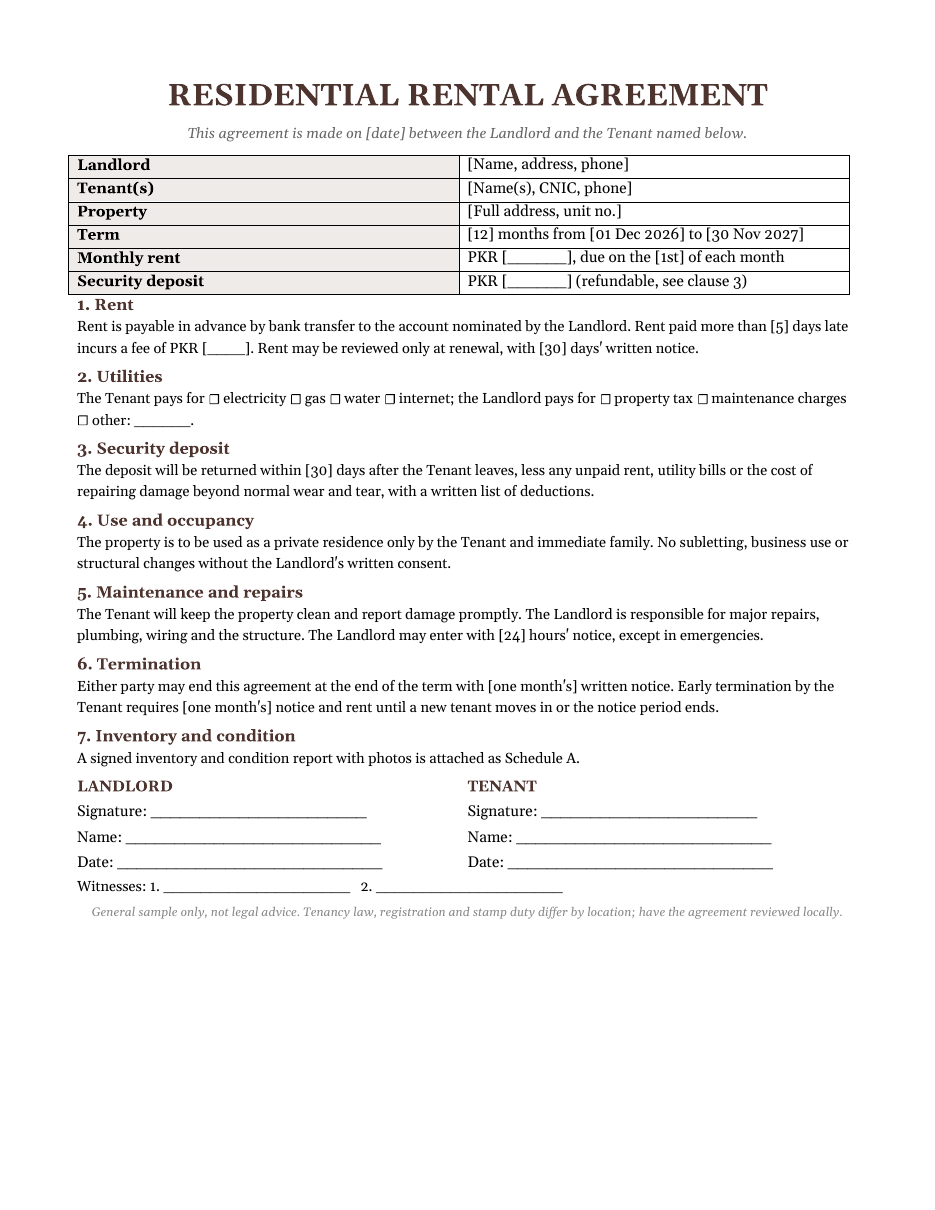
The template opens in Microsoft Word, Google Docs, LibreOffice Writer and Pages. Replace the bracketed fields, tick the utility boxes and print two copies for signing.
What is a rental agreement?
A rental agreement, also called a lease or tenancy agreement, is a contract between a property owner (landlord) and a renter (tenant). It gives the tenant the right to live in the property for a set period in exchange for rent and sets out the responsibilities of both parties. Agreements can be fixed-term, such as twelve months, or periodic, renewing month by month until either party gives notice.
What the template includes
- A summary table with landlord, tenants, property address, term, monthly rent and deposit.
- Rent clause covering payment method, due date, late fees and rent reviews.
- Utilities clause with checkboxes for who pays each bill.
- Security deposit clause with a return deadline and written deductions.
- Use and occupancy rules, including subletting and business use.
- Maintenance and repairs responsibilities and landlord access with notice.
- Termination and notice periods, including early termination.
- Reference to an inventory and condition report.
- Signature blocks for landlord and tenant and two witness lines.
- A short legal disclaimer.
How to fill out the rental agreement
- Enter the date of the agreement.
- Write the landlord's full name, address and phone number.
- Enter the full names and ID numbers of all adult tenants.
- Write the full property address, including the unit number.
- Set the term with start and end dates.
- Enter the monthly rent, due date and payment method.
- Enter the security deposit amount.
- Set the late fee and the grace period.
- Tick which utilities each party pays.
- Agree notice periods for termination and access.
- Prepare an inventory and condition report with photos and attach it as Schedule A.
- Read the whole agreement together, sign two copies with witnesses and keep one each.
Key clauses explained
Rent
State the exact amount, the due date, how it must be paid and the consequences of late payment. Paying by bank transfer gives both sides a reliable record.
Security deposit
The deposit protects the landlord against unpaid rent or damage. The agreement should say how much it is, when it will be returned and how deductions are calculated. Normal wear and tear, such as minor scuffs or faded paint, should not be deducted.
Utilities
Electricity, gas, water, internet and maintenance charges can be paid by either party. Ticking the boxes avoids disputes over unpaid bills.
Use and occupancy
Defines who may live in the property and prohibits subletting or business use without permission.
Maintenance and repairs
Tenants usually keep the property clean and report problems, while landlords handle major repairs, plumbing, wiring and structural issues. Landlords should give notice before entering except in emergencies.
Termination
Sets out how much notice each party must give and what happens if the tenant leaves early.
The inventory and condition report
An inventory is one of the most valuable documents in any tenancy. Before the tenant moves in, walk through the property together and list every room, fixture, appliance and item of furniture with its condition. Take dated photos of walls, floors, fittings and appliances. Both parties sign the list and attach it to the agreement. At move-out, compare the property with the inventory to decide fairly whether any deposit deductions are justified.
Tips for landlords
- Verify the tenant's identity, employment and references.
- Use a written agreement for every tenancy, even with friends or relatives.
- Give receipts for rent and deposits.
- Keep the property safe, with working wiring, gas and smoke alarms.
- Respond to repair requests promptly.
- Give proper notice before visiting.
- Keep copies of all documents and communications.
- Check local rules on registration, police verification, taxes and deposits.
Tips for tenants
- Read the full agreement before signing and ask questions.
- Inspect the property and note every defect in the inventory.
- Take photos when you move in and move out.
- Pay rent on time by a traceable method.
- Report repairs in writing.
- Get the landlord's permission before making changes.
- Give notice in writing when you plan to leave.
- Ask for a written list of any deposit deductions.
Common rental disputes and how to avoid them
Most disputes involve deposits, repairs, rent increases and notice periods. A clear agreement and a signed inventory prevent most deposit disputes. Writing down who handles repairs and how quickly avoids frustration on both sides. Stating that rent can only be reviewed at renewal, with notice, removes uncertainty. Agreeing notice periods in advance means neither side is surprised when the tenancy ends. When problems arise, communicate in writing and refer back to the agreement.
Renewing or ending the tenancy
Near the end of a fixed term, the landlord and tenant should discuss whether to renew. If both agree, sign a short renewal letter or a new agreement with any updated rent and dates. If the tenant is leaving, agree a move-out date, carry out a final inspection against the inventory, read the meters, collect keys and return the deposit within the agreed period with a written list of any deductions. A smooth handover protects both parties and leaves the property ready for the next tenancy.
Legal disclaimer
This rental agreement template is a general sample for information only and does not constitute legal advice. Tenancy laws, registration, stamp duty, deposit rules, eviction procedures and tenant rights vary significantly between countries, provinces and cities. Have the agreement reviewed by a qualified lawyer or property professional in your area before signing.
Rent increases and renewals
Many disputes start with an unexpected rent increase. A fair agreement states when rent can be reviewed, how much notice the landlord must give and, where local law sets limits, that any increase will follow those limits. A common approach is to review rent only at renewal, with at least thirty days' written notice. Tenants can then decide whether to accept the new rent, negotiate or give notice. Recording the agreed increase in a signed renewal letter keeps everything clear.
Pets, parking and house rules
Every property is different, so add clauses that match yours. If pets are allowed, state the type and number, any extra deposit and the tenant's responsibility for damage. For apartments, include parking arrangements, use of shared areas and building rules on noise, rubbish and visitors. If smoking is not permitted, say so clearly. Attaching a short page of house rules as a schedule keeps the main agreement simple while making expectations clear.
Rental agreements for shared houses
When several tenants share a property, decide whether they will sign one joint agreement or separate agreements for each room. Under a joint agreement, all tenants are usually responsible together for the full rent and any damage, which suits friends or families renting together. Separate agreements suit landlords who rent rooms to unrelated people, because each tenant is responsible only for their own room and share of common areas. Either way, list every adult occupant by name and make the arrangement for utilities and shared costs clear.
Frequently asked questions
Is this rental agreement template free?
Yes. Download, edit and print it for residential tenancies.
Can I use it for a room rental?
Yes. Describe the room and shared areas in the property field and adjust the use and utilities clauses.
Does the agreement need to be registered?
In some places, rental agreements must be registered or stamped to be enforceable. Check local requirements.
Can I add extra clauses?
Yes. Add clauses for pets, parking, smoking, furniture or house rules as needed, and have both parties initial any changes.
How much should the security deposit be?
Deposits commonly range from one to three months' rent, but local laws may set limits. Check the rules in your area.
Can the landlord enter the property at any time?
Usually not. The agreement should require reasonable notice, such as 24 hours, except in emergencies. Local law may set specific rules.
Related templates
- Rent receipt templates
- Eviction notice templates
- Agreement templates
- Non-disclosure agreement templates
- Cash receipt template