A clear job description is the foundation of good hiring and good management. It tells candidates exactly what a role involves, helps hiring managers compare applicants fairly, sets expectations for new employees and gives managers a basis for performance reviews, training and pay decisions. Many organizations plan new roles for the coming year in November and December, so this is the ideal time to write or update job descriptions.
Our free job description template for Microsoft Word puts everything on one well-organized page: a job details table with title, department, reporting line, location, salary range and job code; a job purpose statement; key responsibilities; essential and desirable requirements; key performance indicators; working conditions and benefits; and approval and acknowledgement signatures. The sample is written for a Customer Service Executive. Preview it below and download the DOCX.
Download the free job description template
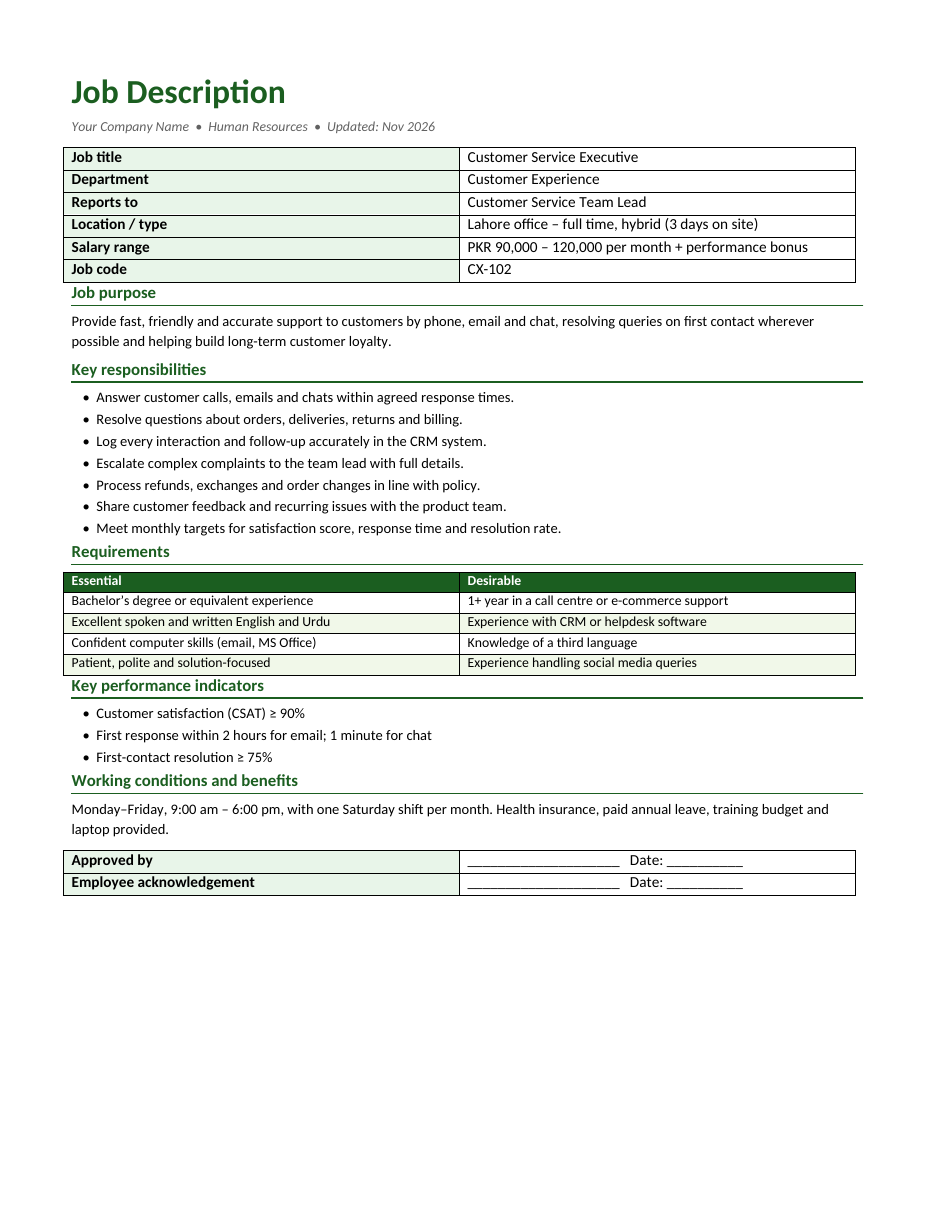
The template opens in Microsoft Word, Google Docs, LibreOffice Writer and Pages. Replace the sample text with your own role details, then save it as a PDF for job adverts or keep the Word file in your HR records.
What is a job description?
A job description is a document that describes the purpose, duties, responsibilities, required skills and working conditions of a specific role. It is used in recruitment adverts, interviews, employment contracts, onboarding, performance reviews and organizational planning. A good job description focuses on what the role must achieve rather than describing one particular person.
What the template includes
- A job details table: job title, department, reports to, location and work type, salary range and job code.
- A one or two sentence job purpose.
- Seven key responsibilities written as clear action statements.
- A requirements table separating essential and desirable qualifications.
- Key performance indicators that show how success is measured.
- Working hours, conditions and benefits.
- Approval and employee acknowledgement lines with dates.
- A clean one-page layout with green headings.
How to write a job description
- Talk to the hiring manager and, if possible, someone already doing the role.
- Choose a clear, standard job title that candidates will search for.
- Fill in the department, reporting line, location, work type and salary range.
- Write a short job purpose: why the role exists and what it achieves.
- List five to eight key responsibilities, starting each with an action verb.
- Separate essential requirements from desirable ones.
- Add two to four KPIs that show what good performance looks like.
- Describe working hours, location rules and key benefits.
- Check the language is clear, inclusive and free of jargon.
- Have the description approved by the manager and HR before publishing.
Writing each section well
Job title
Use a title that matches the level and is common in your industry, such as "Customer Service Executive" rather than an internal nickname. Clear titles help candidates find your advert and understand the seniority of the role.
Job purpose
Summarise the reason for the role in one or two sentences. In the sample: provide fast, friendly and accurate support to customers, resolving queries on first contact and building loyalty.
Key responsibilities
Focus on the main outcomes, not every small task. Start with action verbs such as answer, resolve, log, escalate, process and share. Put the most important responsibilities first.
Requirements
Essential requirements are must-haves without which a person cannot do the job. Desirable requirements are useful extras. Keep the essential list short so you do not discourage good candidates who could learn quickly.
KPIs
KPIs make expectations measurable. For customer service, examples include customer satisfaction, response time and first-contact resolution. KPIs give the new employee and manager a shared understanding of success.
Tips for an effective job description
- Keep it to one or two pages.
- Use plain, direct language.
- Write in the present tense, such as "answers customer calls".
- Avoid biased wording related to age, gender or background.
- Include a salary range where possible; it attracts more relevant applicants.
- Mention hybrid or remote options clearly.
- Review job descriptions every year or when the role changes.
Using the job description in recruitment
Your job description is the base for your job advert, but the advert can be shorter and more promotional. Start the advert with a short paragraph about your company and why people enjoy working there, then include the purpose, main responsibilities, essential requirements and benefits. Use the requirements list to create interview questions and a scoring sheet, so every candidate is assessed against the same criteria.
Using it after hiring
After a person is hired, the job description becomes part of their onboarding. Go through it in the first week, agree priorities and explain how KPIs will be measured. Ask the employee to sign the acknowledgement line and keep a copy in their HR file. Refer back to it during probation reviews and annual appraisals, and update it when responsibilities change.
Job description examples you can create
- Customer service and call centre roles.
- Sales executives and account managers.
- Accountants and finance assistants.
- Administrative and office assistants.
- Teachers and school staff.
- Warehouse and logistics staff.
- Software developers and IT support.
- Marketing coordinators and social media managers.
Sample job description walkthrough
The sample describes a Customer Service Executive in the Customer Experience department, reporting to the Customer Service Team Lead. The role is full time and hybrid, with three days a week in the Lahore office, and the salary range of PKR 90,000 to 120,000 per month plus a performance bonus is stated openly. A job code, CX-102, makes it easy to track the role in HR records and job adverts.
The job purpose explains in one sentence why the role exists: to give fast, friendly and accurate support and to build customer loyalty. Seven responsibilities follow, covering calls, emails and chats, order and billing queries, CRM records, escalations, refunds and exchanges, feedback to the product team and monthly targets. The requirements table lists four essential and four desirable qualifications side by side, so candidates can quickly see whether they qualify. Three KPIs, customer satisfaction of at least 90%, response times and first-contact resolution of at least 75%, make success measurable. The final section explains working hours, the monthly Saturday shift and benefits such as health insurance and a training budget.
Inclusive and fair job descriptions
The words you use affect who applies. Avoid phrases that suggest a particular age, gender or background, such as "young and energetic" or "native speaker", and focus on the skills the job truly needs. Only list a degree as essential if it is genuinely required; otherwise, allow "or equivalent experience". Mention flexible working, accessibility and equal-opportunity commitments if your organization offers them. Fair, specific job descriptions attract a wider pool of qualified candidates and reduce the risk of discrimination complaints.
Job description checklist
- The job title is clear and commonly used.
- The reporting line and department are stated.
- Location, work type and hours are clear.
- The purpose explains why the role exists.
- Responsibilities start with action verbs and focus on outcomes.
- Essential requirements are truly essential.
- KPIs are measurable and realistic.
- Salary range and key benefits are included where possible.
- The document has been approved by the manager and HR.
Building a library of job descriptions
Once you have one good job description, use it as the model for every role in your organization. Keep all job descriptions in one shared folder, named by job code and title, and use the same headings and layout for each. A consistent library makes it easier to compare roles, plan salary bands, spot gaps or overlaps in responsibilities and prepare organization charts. When a role changes, update its description and record the date, so recruiters and managers always use the latest version.
Frequently asked questions
Is this job description template free?
Yes. Download, edit and use it for any role in your organization.
How long should a job description be?
One to two pages is ideal. This template fits a complete description on one page.
Should I include the salary?
Including a salary range is increasingly common and helps attract candidates whose expectations match the role.
What is the difference between a job description and a job specification?
A job description focuses on the duties and purpose of the role; a job specification focuses on the skills, qualifications and experience the person needs. This template includes both.
How often should job descriptions be updated?
Review them at least once a year, and whenever the role changes significantly or before recruiting.
Can I use this template for part-time or contract roles?
Yes. Update the work type, hours and benefits sections to reflect part-time, temporary or contract arrangements.
Who should write the job description?
Usually the hiring manager writes the first draft, and HR reviews it for consistency, fairness and alignment with pay bands.
Can I share the job description with candidates before the interview?
Yes. Sending the full job description with the interview invitation helps candidates prepare and makes the conversation more focused.
Related templates
- Cover letter template
- Resume templates
- Employee tracking templates
- Salary increase letter templates
- Attendance tracking templates