Opening a restaurant is exciting, but it is also one of the riskiest small business ventures. Rent, equipment, staff and food costs add up quickly, and many restaurants struggle in their first year because the numbers were never planned. A restaurant business plan helps you think through every part of the business before you spend money: your concept, customers, location, costs, sales forecast, marketing, team and funding. It is also the document banks and investors will ask for.
Our free restaurant business plan template for Microsoft Word puts a complete plan on one page. It includes an executive summary, a concept and market table, a startup cost budget, a Year 1 quarterly financial forecast, marketing, operations and team plans, and a funding request. The sample is for "Spice Route Kitchen", a 60-seat Pakistani and BBQ restaurant. Preview it below and download the DOCX.
Note: the figures are an illustrative example only. Forecasts depend on your own assumptions, and this template is not financial, legal or investment advice. Consult an accountant or business adviser before making financial decisions or applying for loans.
Download the free restaurant business plan template
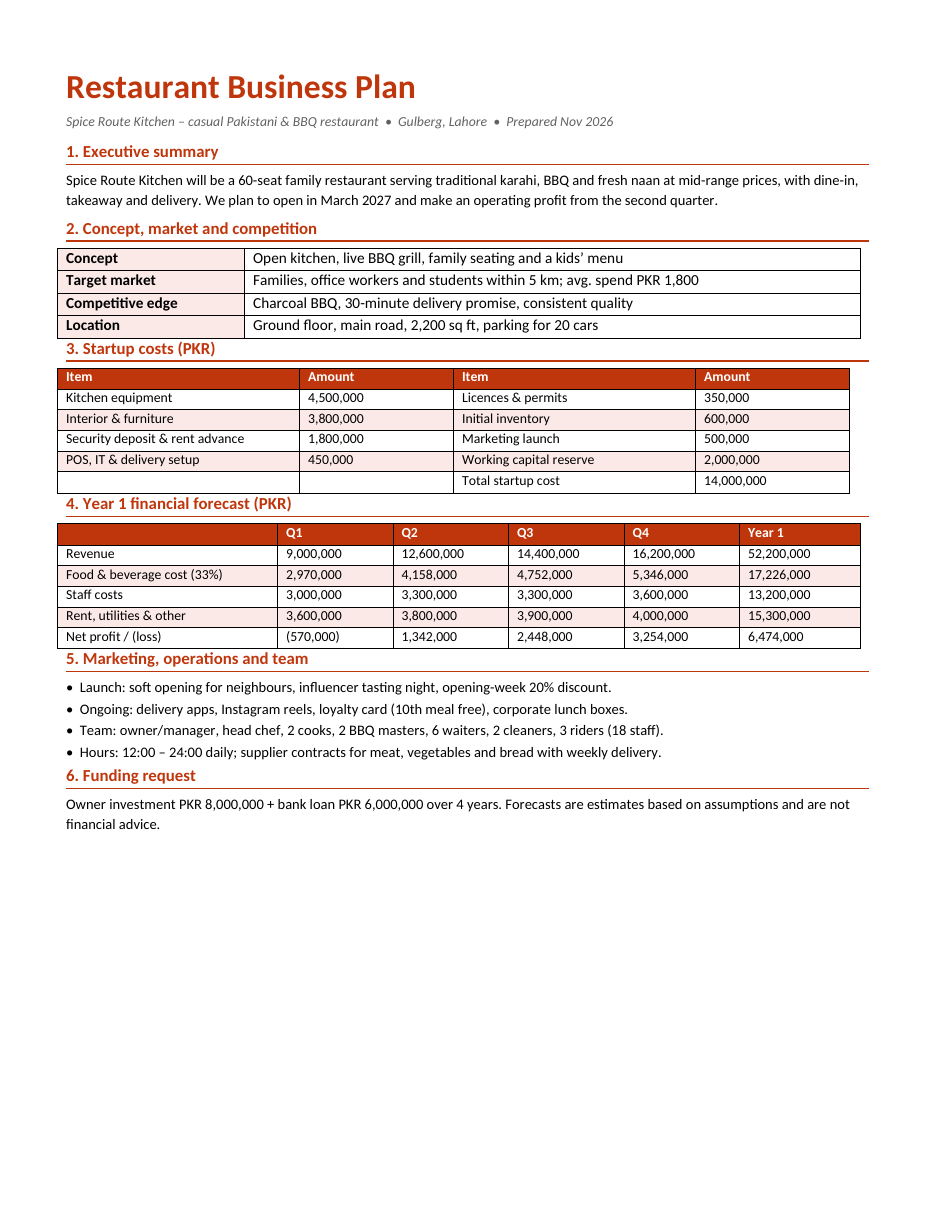
The template opens in Microsoft Word, Google Docs, LibreOffice Writer and Pages. Replace the sample text and numbers with your own, and expand each section into a longer plan if a lender requires more detail.
What the template includes
- Restaurant name, cuisine, location and date.
- A short executive summary.
- Concept, target market, competitive edge and location.
- A startup cost table with eight cost categories and a total.
- A Year 1 forecast by quarter: revenue, food and beverage cost, staff costs, rent and other costs, and net profit.
- Launch and ongoing marketing plans.
- Team structure and opening hours.
- Funding request with owner investment and loan.
- A note that forecasts are estimates, not financial advice.
How to write a restaurant business plan
- Define your concept: cuisine, style, price level and atmosphere.
- Research your target customers and how much they spend.
- Visit competitors and note their prices, menus and busy times.
- Choose a location and check rent, parking, footfall and permits.
- List every startup cost, from kitchen equipment to licences.
- Estimate monthly sales based on seats, table turns and average spend.
- Estimate food cost as a percentage of sales.
- Plan your staff and their wages.
- Add rent, utilities, marketing and other monthly costs.
- Calculate profit for each quarter of the first year.
- Plan your opening and ongoing marketing.
- Decide how much funding you need and where it will come from.
Writing each section
Executive summary
Write this last, but put it first. In three or four sentences, describe the restaurant, what makes it special, when it will open and the main financial goal.
Concept and market
Explain what customers will experience and why they will choose you. The sample targets families, office workers and students within five kilometres, with an average spend of PKR 1,800, and competes on charcoal BBQ, fast delivery and consistent quality.
Startup costs
Be thorough. The sample budget totals PKR 14 million, including PKR 4.5 million for kitchen equipment, PKR 3.8 million for interiors and furniture, rent deposits, licences, initial inventory, launch marketing and a PKR 2 million working capital reserve.
Financial forecast
The sample forecast shows revenue growing from PKR 9 million in the first quarter to PKR 16.2 million in the fourth, as the restaurant becomes known. Food and beverage costs are 33% of revenue. The first quarter shows a loss of PKR 570,000, which is common for new restaurants, and the year ends with a net profit of PKR 6.47 million.
Key restaurant numbers to understand
- Food cost percentage: food and drink costs divided by sales, often 28 to 35%.
- Labour cost percentage: staff costs divided by sales.
- Prime cost: food plus labour costs; many operators aim to keep it below about 60 to 65% of sales.
- Average spend per customer.
- Table turnover: how many times each table is used per meal period.
- Break-even point: the sales needed to cover all costs.
Marketing your new restaurant
- Hold a soft opening for neighbours and friends to test service.
- Invite local food bloggers and influencers to a tasting night.
- List on delivery apps from day one.
- Post short videos of the kitchen and dishes on social media.
- Offer an opening-week discount and a loyalty card.
- Target nearby offices with lunch boxes and catering.
- Ask happy customers for reviews.
Common mistakes to avoid
- Underestimating startup costs and running out of cash.
- Choosing a location with low footfall or no parking.
- Overcomplicated menus that increase waste.
- Not tracking food cost every week.
- Hiring too many staff before sales grow.
- Spending all marketing money before opening.
Building your sales forecast step by step
The sales forecast is the heart of a restaurant business plan, and lenders will look closely at how you built it. Start with your capacity: the number of seats, the number of days you are open and the meal periods you serve. Then estimate how many times each seat will be used per meal period, which is called table turnover. A new restaurant should be cautious and assume low turnover in the first months.
Multiply covers by your average spend per customer to get daily revenue. For example, 60 seats, filled 1.2 times at dinner and 0.5 times at lunch, is about 100 covers a day. At an average spend of PKR 1,800, that is roughly PKR 180,000 a day before delivery orders. Add a separate estimate for delivery and takeaway, which can be a large share of sales for many restaurants. Finally, test a pessimistic case: what happens if sales are 20% lower than you expect?
Planning your costs
Food and beverage cost changes with sales, so it is usually forecast as a percentage of revenue. Staff, rent and most utilities are largely fixed, which is why the first quarter is often loss-making: the fixed costs arrive before customers do. Build a menu costing sheet for every dish to check that your food cost target is realistic, and review supplier prices regularly.
- Fixed costs: rent, salaried staff, insurance, software subscriptions and loan repayments.
- Variable costs: ingredients, packaging, delivery commissions and card fees.
- Semi-variable costs: utilities, hourly staff and maintenance.
Presenting the plan to lenders and investors
- Keep the executive summary short and specific.
- Show that you understand your customers and competitors.
- Explain the assumptions behind every forecast number.
- Include your own investment; lenders like to see the owner sharing the risk.
- Show a cash reserve for the slow first months.
- Attach CVs of the owners and head chef if requested.
- Be ready to explain what you will do if sales are slower than planned.
The sample requests PKR 14 million: PKR 8 million of owner investment and a PKR 6 million bank loan repaid over four years. Whatever the amounts in your plan, make sure the funding covers all startup costs plus a working capital reserve.
Turning the plan into action
A business plan is not only for raising money. Once the restaurant is open, compare your actual sales and costs with the forecast every month. If food cost is higher than planned, review portion sizes, waste and supplier prices. If sales are lower, look at your marketing, opening hours and menu. Update the plan every quarter so it stays a useful management tool rather than a document that sits in a drawer.
Set a few simple targets for the team, such as average spend, customer review scores and food cost percentage, and share progress at weekly meetings. Small improvements in these numbers make a large difference to profit over a year.
Frequently asked questions
Is this restaurant business plan template free?
Yes. Download, edit and use it for your restaurant, café or food business.
How long should a restaurant business plan be?
A one-page plan is great for clarity and planning. Lenders may ask for a longer plan with detailed market research and three-year financial forecasts.
Can I use it for a café, bakery or food truck?
Yes. Change the concept, seating, costs and forecast to suit your business.
Are the numbers in the template realistic?
They are an illustrative example. Your costs and sales will depend on your location, concept and market. Always build forecasts from your own research.
Do I need an accountant?
It is strongly recommended to have an accountant or adviser review your forecasts, taxes and funding plan before you commit money.
What is a good food cost percentage?
Many restaurants aim for roughly 28 to 35%, but the right figure depends on your cuisine, prices and concept. Track it weekly.
Should I include a three-year forecast?
For a bank loan, usually yes. Use this one-page plan as a summary and add detailed monthly forecasts as an appendix.
Can I edit the tables in Word?
Yes. All tables are standard Word tables, so you can add rows for extra cost items, change the quarters to months or add a second year.
Related templates
- Strategic plan template
- Menu templates
- Cost-benefit analysis templates
- Executive summary templates
- Recipe card templates