
Every time goods leave a warehouse on a truck, a carrier needs to know what is being shipped, where it is going and who is responsible for it. The bill of lading (BOL or B/L) is the document that records this. It acts as a receipt from the carrier, a record of the shipment details and evidence of the terms under which the goods are carried. A clear, complete bill of lading prevents disputes about missing or damaged goods and helps shipments move smoothly.
Our free bill of lading template for Excel is a short-form straight bill of lading on one printable page. It includes the B/L number, date, carrier and vehicle number, shipper and consignee blocks, freight charge terms, special instructions, a cargo table with automatic totals for handling units, packages and weight, a declaration and three signature lines. The sample records a furniture shipment from Lahore to Karachi. Preview it below and download the XLSX.
Download the free bill of lading template
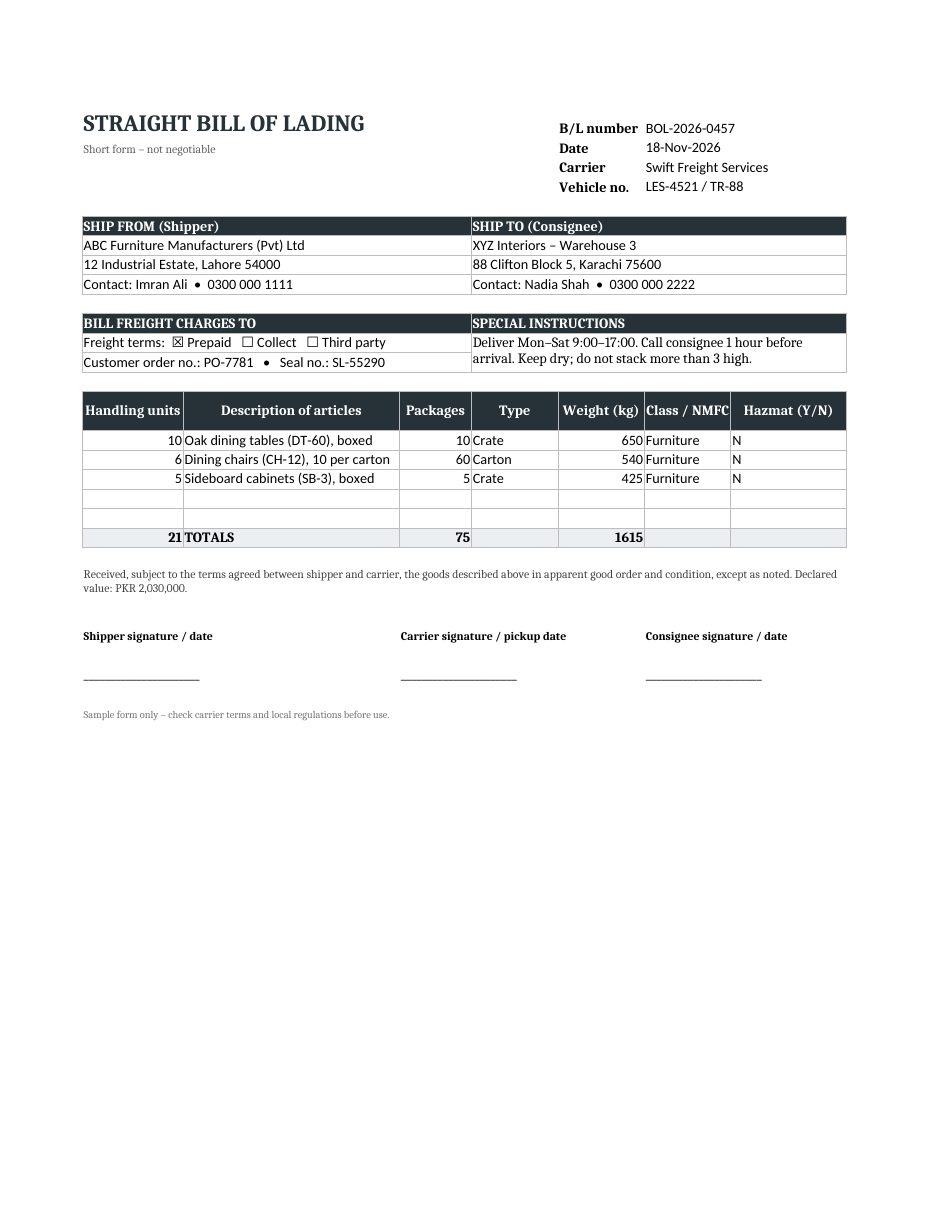
The template works in Microsoft Excel, Google Sheets and LibreOffice Calc. It is a sample form for general use; check your carrier's terms and any local or international shipping regulations before relying on it.
What is a bill of lading?
A bill of lading is a document issued or signed by a carrier that confirms it has received goods for shipment. It describes the goods, names the shipper and consignee, states the destination and records the terms of carriage. It has three main functions: it is a receipt for the goods, evidence of the contract of carriage and, in some forms, a document of title that controls who can collect the goods.
Straight vs order bill of lading
A straight bill of lading names a specific consignee and is not negotiable: only the named consignee can receive the goods. It is common for domestic shipments and prepaid goods. An order bill of lading is negotiable and can be transferred to another party by endorsement, which is common in international trade and letter-of-credit transactions. This template is a straight, non-negotiable bill of lading for everyday domestic shipments.
What the template includes
- B/L number, date, carrier name and vehicle or trailer number.
- Ship from (shipper) name, address and contact.
- Ship to (consignee) name, address and contact.
- Freight terms: prepaid, collect or third party.
- Customer order number and seal number.
- Special delivery and handling instructions.
- A cargo table with handling units, description, packages, packaging type, weight, class and hazmat indicator.
- Automatic totals for handling units, packages and weight.
- A receipt declaration with declared value.
- Signature lines for shipper, carrier and consignee.
How to fill out a bill of lading
- Enter a unique B/L number and the shipping date.
- Fill in the carrier name and vehicle or trailer number.
- Enter the shipper's full name, address and contact person.
- Enter the consignee's name, delivery address and contact.
- Tick the freight terms that apply.
- Add the customer purchase order number and seal number.
- Write any special instructions, such as delivery hours or handling notes.
- List each line of cargo with units, description, packages, type and weight.
- Mark any hazardous materials clearly.
- Check the totals and declared value.
- Print three copies: for the shipper, carrier and consignee.
- Get the carrier's signature at pickup and the consignee's signature on delivery.
Key fields explained
Handling units and packages
Handling units are the pieces the carrier physically moves, such as crates or pallets. Packages are the individual items or cartons inside. In the sample, 21 handling units contain 75 packages: 10 table crates, 60 chairs packed in 6 cartons and 5 sideboard crates.
Weight
Record the gross weight of each line. The total weight, 1,615 kg in the sample, helps the carrier plan loading and calculate charges.
Freight terms
Prepaid means the shipper pays the freight; collect means the consignee pays; third party means another company, such as a distributor, pays.
Hazmat
Hazardous materials need special labelling, documentation and handling. Never ship them without following the applicable regulations.
Tips for accurate bills of lading
- Describe goods clearly; avoid vague words like "goods" or "misc".
- Count packages and weigh shipments before pickup.
- Match the details with the packing list and invoice.
- Record seal numbers for sealed trailers or containers.
- Note any visible damage at pickup on the B/L.
- Ask the consignee to note shortages or damage before signing.
- Keep signed copies with your shipping records.
Bill of lading vs packing list vs invoice
The bill of lading is the carrier's document for the movement of goods. A packing list details exactly what is in each package, for checking on arrival. A commercial invoice states the price and payment terms for the sale. A typical shipment includes all three, and the details on each should match.
Who uses a bill of lading template?
- Manufacturers shipping goods to customers.
- Wholesalers and distributors.
- Small trucking and logistics companies.
- Warehouses and fulfilment centres.
- E-commerce businesses sending bulk orders.
- Importers moving goods inland from ports.
Worked example: the sample shipment
The sample bill of lading records a shipment of dining furniture from a manufacturer in Lahore to a retailer in Karachi. Ten dining tables travel in individual wooden crates, sixty chairs are packed ten to a carton in six cartons, and five sideboards each travel in their own crate. The freight is prepaid by the shipper, the trailer is sealed and the seal number is written on the form, so the consignee can check that the seal is intact on arrival. The special instructions ask the carrier to deliver Monday to Saturday between 9:00 and 17:00, call the consignee an hour before arrival, keep the goods dry and not stack them more than three high.
Because each line records both handling units and packages, the carrier knows it must load 21 pieces, while the consignee knows to count 75 packages when unloading. If anything is missing or damaged, the difference can be noted on the bill of lading before it is signed, which makes any claim far easier to resolve.
Customising the Excel template
- Add your company name and logo above the title.
- Change the currency and declared value field to match your country.
- Add columns for dimensions or NMFC numbers if your carrier needs them.
- Use data validation for freight terms and hazmat fields to keep entries consistent.
- Protect the formula cells so totals cannot be overwritten by mistake.
- Save a blank copy as a master and use Save As for each new shipment.
- Set the print area so the form always prints on a single A4 or Letter page.
Keeping shipping records organised
A signed bill of lading is often the first document requested when a customer reports a shortage or a carrier disputes a charge. Name each file with the B/L number and date, keep a scanned copy of the signed version, and store it alongside the matching invoice and packing list. A simple shipping log listing B/L numbers, dates, carriers, consignees and delivery status makes it quick to find any shipment later.
Many businesses keep bills of lading for several years for tax, audit and insurance purposes. Check the record-keeping rules that apply to your business and industry.
Responsibilities of shipper, carrier and consignee
The shipper is responsible for describing, counting, packing and labelling the goods correctly and for declaring any hazardous materials. The carrier checks the load against the bill of lading at pickup, signs to confirm receipt and is responsible for the goods while they are in transit, under the terms of carriage. The consignee checks the delivery against the bill of lading, notes any exceptions and signs to confirm receipt. When every party does its part, the signed form becomes a reliable record of the shipment.
Frequently asked questions
Is this bill of lading template free?
Yes. Download, edit and use it for your shipments.
Who issues the bill of lading?
Usually the carrier issues or signs it, but shippers often prepare it and the carrier signs at pickup.
How many copies do I need?
Typically three: one for the shipper, one for the carrier and one for the consignee.
Can I add more cargo lines?
Yes. Insert rows inside the cargo table and check that the total formulas include them.
Is a bill of lading the same as a delivery note?
Not exactly. A delivery note confirms what was delivered to the customer, while a bill of lading is the carrier's receipt and contract of carriage.
What happens if goods arrive damaged?
The consignee should note the damage on the bill of lading and delivery receipt before signing, take photos and inform the carrier and shipper promptly so a claim can be made.
Can I use this form for international shipments?
International shipments often need an ocean or air bill of lading issued by the carrier, plus customs documents. This template is designed for simple domestic road shipments.
Does the form need a seal number?
Only if the trailer or container is sealed. Recording it helps prove the load was not opened in transit.
Related templates
- Packing list templates
- Shipping label template
- Purchase order template
- Sales contract template
- Certificate of origin templates